



That is the key message from a wide-ranging review of local authority waste management practices published today (June 4) by the Local Government Association, which represents 412 local authorities across England and Wales. The review is entitled Wealth in Waste.
Recommendations in the review include the Treasury freezing landfill tax and returning tax receipts to local authorities to invest in recycling infrastructure; revisions to the PRN and WEEE producer responsibility systems to provide more direct benefit for councils; and, the introduction of landfill bans for furniture, paint and textiles.
Elsewhere, the review highlights the potential for councils to obtain a greater share in the revenue of recyclables they collect. Whilethe LGAacknowledges that income generated per tonne has increased in recent years, the review says that councils still only receive 28% of the financial value of material and suggests that if this increased to 40%, it would provide additional income of over 820 million by 2019/20.
Launchingthe review, councillor Mike Jones, chairman of the LGAs environment and housing board, said: The market growth we want to see does not need to come from recycling more although pushing up the recycling rate would of course grow the market and is feasible.
What we have found is that there are hundreds of millions of pounds of unrealised value for the taxpayer and the economy if we can simply get the market for todays amount of recycling to function better. This review makes recommendations for simple changes that would improve the market and let it prosper.
Review
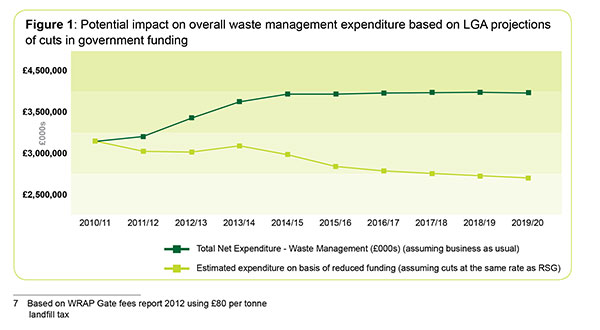
At present, councils in England and Wales spend 3.2 billion a year on collecting and disposing of 23 million tonnes of waste. But, with budgets under pressure the review was launched at the end of 2012 to look at what local authorities can afford and to influence government policy (see letsrecycle.com story).
Its work has been steered by the LGAs environment and housing board and shaped by a Challenge Group which met twice, in December 2012 and March 2013. The group was led by elected members under the chairmanship of Waltham Forest councillor Clyde Loakes and included Lambeth Councillor Clare Whelan; Eastleigh councillor Keith House; and, Babergh councillor Peter Jones.
A total of 19 organisations were represented in the group including Defra, DCLG, the Environment Agency, LARAC, NAWDO, CIWM and ESA.
Landfill Tax
On the subject of landfill tax, the LGA says the government has raked in around 3 billion from local taxpayers in the last five years and is punishing councils and residents, despite recycling rates increasing from 13% to 43% in a decade.
Councillor Clyde Loakes, who chaired the review, said: Residents have played their part. By helping us recycle more and more every year they are helping councils save money on the cost of processing the bins, yet they are being punished, not rewarded, because of the crippling rate rises in landfill tax.
By freezing the landfill tax at its current rate and reinvesting the money through joint council and private sector waste projects, the Treasury could help us stimulate growth, create jobs and boost an important revenue stream for local authorities to limit the impact of budget cuts on local taxpayers and help us continue to deliver the services our residents rely on, from keeping libraries open to caring for the elderly.
He continued: Having already had to cope with 33% funding cuts and with further cuts expected in the upcoming Spending Round, councils know better than anyone how tight public finances are at the moment. But continuing to cream off increasing landfill tax receipts to balance the Governments books is not only unfair to taxpayers, it also misses a genuine opportunity to turn the UKs waste and recycling sector into a world leader.
Producers
With regards to producer responsibility, the review states that producers must pay their share. It explains that in 2012, 62 million was recovered from packaging manufacturers and producers under the PRN system but that this was dwarfed by the estimated 550 million cost incurred by local authorities in 2011/12 in collecting and sorting waste packaging.
The review says: Government must use its upcoming review of the PRN system to rebalance the costs between producers and the tax payer to ensure producers are paying their fair share
“There is clearly wealth in waste. The UKs waste and recycling sector is currently worth around 11 billion and growing at twice the rate of the rest of the economy, but there is so much more we could do to make the most of this booming industry”
Councillor Clyde Loakes
The review also calls for councils to see more benefit from the producer responsibility system for waste electrical and electronic equipment (WEEE), urging the government to use its current review of the WEEE system to enable councils to access a greater proportion of the value of these materials.
And, with regards to businesses, it calls for a more effective agreement than Courtauld to be reached to encourage waste reduction.
It says: While covering the majority of the grocery market, only 45 retailers, brands and manufacturers are signed up to the Courtauld Commitment at present and the agreement only represents what the industry is willing to offer. It represents a one-sided and partial bargain. There is significant scope for greater progress in this area.
Recommendations
The full list of recommendations in the Local Waste Review are:
1: Freeze the landfill levy at its 2014/15 level.
2: The MRF Code of Practice should require full transparency of information and a robust system of sampling to improve confidence in quality.
3: Amend the PERN system and improve enforcement at ports of waste exports so that the domestic reprocessing industry has a level playing field.
4: Revise the PRN system to include greater transparency, a direct incentive to local authorities for increasing their capture of packaging for recycling and an incentive for producers to use more recycled material and better design for recycling.
5: Revise the WEEE compliance arrangements to ensure that local authorities that collect and store WEEE have the ability if they wish to manage and receive an appropriate income for it. There should also be additional incentives to reuse an increasing proportion of WEEE while providing assurance that the material will not be illegally exported and landfilled overseas.
6: Introduce targeted landfill bans in the UK on selected materials potentially furniture, paints, and textiles and link them to an increased producer contribution to encourage recycling and reuse.
7: Landfill tax receipts from local authorities should be redistributed to local taxpayers. One option for the proportion raised from the commercial sector is to provide capital for waste infrastructure projects, e.g. by capitalising the Green Investment Bank or establishing a network of local Waste and Recycling Boards for investment in recycling infrastructure.
8: Build on the principles of the Courtauld Commitment with a new agreement binding more businesses and directly involving local authorities. The LGA is willing to convene discussions and lead a negotiation process.
9: To build the reuse market, develop a reuse product standard that will provide quality assurance to consumers.
10: Introduce a tax incentive for reused and refurbished products, possibly by pressing in Brussels for a lower rate of VAT.
Related Links
11: To drive public debate about reuse, the LGA proposes to establish a Reuse Commission tasked with reporting by the end of 2013 on measures government, councils, businesses and the voluntary sector can take to mainstream reuse.
12: The Government should recognise that kerbside collection arrangements such as the frequency of waste collections – reflect a local deal between councils and their residents and are not a proper subject of national policies.


Register for free to comment