



The company behind it believes it could divert thousands of batteries from landfill by making charging more convenient.
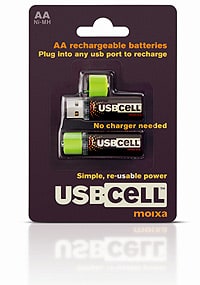 USBCells are now on sale in over 600 stores of Currys, Currys Digital and PC World |
The so-called USBCells can be recharged simply by plugging them into computers after flipping-off the lid.
Designed by London technology firm Moixa Energy, the AA nickel metal hydride batteries have been stocked by Dixons Group International in 600 Currys, Currys Digital and PC World Stores.
Jonathan Marsh, international essentials buyer for the DSGi, said: “The USBCell is a truly revolutionary step towards the next generation of battery products and DSGi wants to stay at the forefront of this new technology. Not only does the product look and function superbly, but it also has an environmentally friendly aspect to it by reducing battery wastage, something the DSGi is keen to support.”
Chris Wright, design director at Moixa Energy, told letsrecycle.com that Moixa was aiming to educate people about the benefits of using rechargeable batteries in the run-up to the Battery Directive coming into force in the UK (see letsrecycle.com story).
Directive
Under the Directive, battery producers and retailers will be made responsible for collecting and recycling spent batteries, and the UK will have to collect 25% of portable batteries by 2012 – despite only collecting around 0.5% in 2002.
Mr Wright explained that the new batteries would also come under the Waste Electrical and Electronic Equipment Directive – as they were classed as both a battery and a charger.
He said: “Our batteries are a safe rechargeable chemistry and we offer a freepost address on our website so they can be posted back to us for recycling.”
He added: “The product is nominally the same as other rechargeable but people don't recharge them as much as possible because they need a charger. We are making charging hugely more convenient. Our batteries can save 500 or 1,000 disposable batteries from landfill by being reused 500 or 1,000 times.”
WRAP
Chris Davey, who is responsible for the Waste and Resource's Action Programme's battery recycling trials, said that from a practical point of view the batteries might encourage people to use more rechargeable cells.
However, he stressed that the Directive concentrated on recycling all batteries regardless of chemistry and that rechargeable batteries would still have to be collected at the end of their lives.
He said: “We still need to collect 25% regardless of their chemistry. WRAP does not support rechargeable or disposable batteries per se but looks at collecting them.”

Register for free to comment