

Speaking at a fringe event organised by Suez recycling and recovery UK in Glasgow, alongside the COP26 meeting, Professor Mark Maslin of University College London, said: “I think the waste industry will always will be with us because they are going to be absolutely key.”

Responding to an audience question about the place of the waste sector in the climate change battle, he emphasised the part it played in capturing secondary raw materials.
“I get a lot of climate deniers going ‘think of all the horrible mining of rare earth elements we need to do for the green revolution’.”
Professor Maslin continued: “Yes absolutely, but the interesting thing is that over the next 30 years is that if we actually mined the lithium we need and also all the other rare earth elements, then you lot [the waste sector] can recycle them at as highest a percentage as possible, and we start to get that circular economy that actually means that mining ceases to be required.
“Waste is suddenly so important for the green economy because it can reduce the amount of environmental destruction around the world. Can you imagine the waste industry making mining in 30 years completely useless? You have to rethink what the waste industry is and what it can contribute to society.”
Design
The professor also highlighted the role of design in planning products. He declared: “We need governments to have joined up thinking, which doesn’t necessarily happen at Westminster at the moment. We need governments to look at regulation, supporting the idea that you look at product from its birth, in the designers head, and you build in its actual reuse and waste disposal in the first draft.”
John Scanlon, chief executive of Suez UK, explained to the event how as a big company it working across all parts of the business, small and large, on diversity and how its impact can be reduced and how carbon can be cut.
He referenced how Suez UK moves a million tonnes of materials by train and is going to look at ways to get better payloads.
Mr Scanlon also highlighted the importance of reuse shops, with Suez having four in Manchester and planning a reuse hub next year. These will generate enough cash to donate £300,000 to local charities each year, he said.
“Companies like Suez and others are poised, primed and ready to make tens of billions of pounds of investment” – John Scanlon, Suez
Carbon capture
One area where he sounded a note of alarm was over carbon capture from energy from waste facilities. This is against a background where parts of the waste industry are hoping to get support from government to develop carbon capture, potentially through the sale of carbon certificates as a form of support mechanism.
The Suez UK chief executive said: “Great that government has embraced carbon capture… it hasn’t gone quite far enough in my book, it hasn’t said it will include energy from waste facilities. It says it is minded to, but hasn’t confirmed it will. It has to confirm that energy from waste facilities are included. If it does there is the potential for millions of tonnes each year to be captured. Again that’s really important for us as a nation.
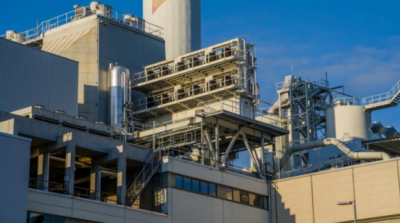
“Companies like Suez and others are poised, primed and ready to make the tens of billions of pounds of investment in facilities needed, in new recycling sites, new sorting sites and new anaerobic digestion plants and new energy plants and climate capture facilities, but clearly we have to have the legislation there that will support us in doing that.”
Deposit scheme
Lorna Slater, minister for green skills, circular economy and biodiversity at the Scottish Parliament spoke online to the event, explained Scotland’s ambitions. This included a 20p per deposit per item and a Circular Economy Bill.
She also said that “food waste will be unacceptable” but there has been strong long term progress in cutting waste and emissions in the resources and waste sector over the past 20 years.
“However we still face significant reduction challenges in targets, and specifically the emissions reduction target set out for the waste sector to 2025, 2030 and beyond.”
The minister said all parts of the value chain will have to be looked out with a need for everyone to recognise the benefits of a circular economy.
Territorial
Dr Marcus Gover, chief executive of WRAP, said that at COP26 the focus is very much on territorial emissions but “nobody’s very much talking about consumption apart perhaps from Greta who held them all up to account yesterday, particularly the UK, saying we haven’t reduced our emissions by 44%, much less than that. She was basically right.”
Dr Gover showed a graph of how the UK is addressing its carbon emissions using carbon budgets.
He explained: “The blue line is the carbon budget being proposed, its very ambitious and you can see the reduction happening until 2037, the orange bar is what BEIS has projected will happen, doing well up to 2020 and then looking more challenging as you go through. The green bars are consumption emissions from international aviation and shipping and also from the products that we use and particularly the ones we import and you can see there the reduction is that much less.
“That is what the world cares about, how we do there. That’s our responsibility really for the world and if we worry about what we do with the products and materials and resources that are in there, then we will be helping other countries reducing their emissions as well. It is where the role of businesses comes in in terms of leadership and where the role of materials and resources comes in. If you look at the UK, from an environmental count, we produce around
200 million tonnes of waste, greenhouse gases associated with that are also about 200 million tonnes. That’s what we are about reducing, that’s our challenge.”

Food
Food is responsible for about 40% of greenhouse gases in the world and is the biggest diversity loss, user of land and water, said Dr Gover. He went on to say that while food waste regulations are coming for England, “we need them faster” and he wondered whether there was a way for local authorities and businesses to ‘spearhead” that faster – businesses don’t have to wait for regulations.
Food waste is about 8-10% of the world’s greenhouse gas emissions, much more than flying.
Duncan Simpson from the Scottish Resources Association explained how the organisations members, mainly SMEs, were the first line that small businesses would go to for advice on the circular economy.
Recycling
During the questions and answer session the topic of getting people to recycle more was raised. Mr Scanlon said generally a big step to promoting recycling was taken when the amount of residual waste is limited.
He questioned at his own home whether what what he needs is a 240 litre bin for even if it is only collected every two to three weeks – “the only problem now is plastic films for which a route is needed for. We need to look at the amount of restricting the amount of residual waste that can be taken away.

Register for free to comment