


But the claims contradict research set to be published in January by the Sports and Play Construction Association (SAPCA). The research suggests contaminants found in recycled material are negligible, and recycled tyres are as good as, if not better, than virgin material.
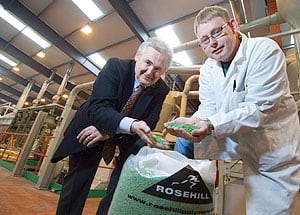 Rosehill Polymer’s sales and marketing manager, Stuart Wilson (left) and TPV project manager Nick Hope with the company's TPV granules. |
Launching its new virgin “Thermo Plastic Vulcanised (TPV)” granules, West Yorkshire firm Rosehill Polymers said that the product had a “range of advantages” over their recycled rubber competitors.
The TPV product can be used as a bonded top layer for sports and playground surfaces, or as a loose infill for synthetic grass pitches. Sowerby Bridge-based Rosehill has secured export orders for over 1 million of the product, and is particularly targeting markets in North America.
Denise Fox, business development manager, said: “Because it is made of virgin polymer it scores heavily over other products in terms of consistency, colour and performance levels.”
“Harmful”
Stuart Wilson, sales and marketing manager at Rosehill, added that there were concerns in Scandinavia that recycled granules created a “harmful run off” when wet.
He said: “Schools and local authorities in these countries are worried about the environmental effects of using recycled tyre rubber. However, they know that because TPV is manufactures from a high quality virgin polymer it is a 'c;lean' product which, even when wet, does not produce any harmful run-off.”
The claims were rebutted by polymer expert Dr Bryan Willoughby, currently preparing his research for the SAPCA, who warned against “sweeping statements” that did not take into account the full environmental benefit of using recycled tyres.
Mr Willoughby said: “Provided tyres are tested for contaminants, the risk to human health is no more than they would find in their own homes.”
The research told letsrecycle.com today that neither virgin nor recycled material could claim to be better, and that even though the recycled material was older, it benefited from the fact that tyres were “superbly engineered” on a large scale – making the polymers more consistent than those often produced by smaller manufacturers.
| Related links: |
He said: “People seem to focus on the small issues and miss the bigger picture. Tyres can have contaminants due to their exposure to the environment and there can be local issues such as impact on tiny water organisms from zinc within a few inches of the granulate. But this should be contrasted with the 440,000 tonnes of scrap tyres produces in the UK a year which are a huge pollution risk if burned.
The polymer chemist, who is currently sitting on a task group for CEN, the European committee for standardisation to scrutinise the issues regarding recycled tyres, added: “From the data I've seen I wouldn't have any concerns.”

Register for free to comment