


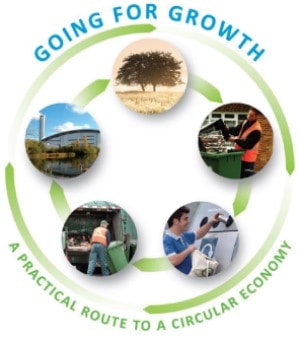
The ESA report, Going for Growth a practical route to a circular economy, outlines 10 recommendations to help the waste and resources industry deliver a circular economy, including the creation of a ministerial post at the Department for Business, Innovation and Skills (BIS) to lead on resource efficiency across government.

Furthermore, while the ESA argues that recycling should continue to take place at multi-stream or single-stream Material Recovery Facilities (MRFs), it calls for less glass to be collected in fully-commingled collections with more of what is collected sorted by advance optical sorters to re-melt quality.
The report also highlights the importance of improved product and packaging design such as avoiding packaging that fuses different materials together as the ESA estimates that 80% of the environmental impact of products is determined at the design stage.
As such, the ESA is calling on experts from waste management companies to work with product and packaging designers to help them understand the practical impacts of design choices, as proposed by the Royal Society of Arts (RSA).
The ESA also supports RSA recommendations for circularity to be embedded into the design education system and calls on the EU to set recyclability requirements for selected products in order to shape the design and investment decisions of manufacturers.
With regards to collections, the report argues that most food waste should be collected separately from households and businesses and for investment in new processing infrastructure such as anaerobic digestion (AD), to where the ESA believe most food waste should be sent. It also recommends that standard clauses in local authority collection contracts should be developed to better allocate recyclate price risk.
If current local authority best practice was replicated across the UK, according to the ESA, an extra five million tonnes of household recyclables with a value of 500 million could be collected.
Progress
However, the ESA feels that progress towards a circular economy remains slow, due to limited demand for recycled products, volatile recyclate markets and that many of the perceived easy wins to boost recycling have already been implemented.
This report explains the waste and resources industrys role at the heart of the circular economy’
David Palmer-Jones, ESA chairman
In order to boost demand for recyclate, the one of the ESA recommendations calls for the EU to add products with high recycled content to the list of VAT (value-added tax)-reduced goods and for specifications for recycled products in Government Buying Standards (GBS) to be increased as the existing GBS are unambitious.
Should the a circular economy become a reality, the ESA estimates a 3 billion boost to the UKs GDP, while the number of new jobs at recycling, energy from waste, composting and AD facilities could total more than 30,000.
Chairman of the ESA, David Palmer-Jones, said: The circular economy is the best long-run approach to return the UK to sustainable growth.
This report explains the waste and resources industrys role at the heart of the circular economy. It highlights some of the barriers preventing the take up of greater circularity and offers solutions along the supply chain. We believe that the circular economy can only be built if all parts of the supply chain work together.
Recommendations
The recommendations outlined in the report are as follows:
- Letsrecycle.com is hosting a webinar on June 28 – ‘7 Practical Steps to a Circular Economy: Guidance for the Retail Sector’ – featuring leaders & experts from the world of retail, recycling, and waste management. You can sign up now and tweet your questions in advance. For more details, visit: Webinar.
1: Waste management companies to contribute experts to the design for recyclability spaces proposed by RSA. This will help designers understand the practical impacts of design choices.
2: EU to use powers within the Eco Design Directive to set recyclability requirements for selected products. This will start to shape the design and investment decisions of manufacturers supplying the EU market.
3: A BIS Ministerial post should be created to lead on Resource Efficiency across Government, linking the current emphasis on industrial policy with the material resources agenda. This will mitigate the problem of waste and resources being a second-tier issue for multiple government departments.
4: EU should consider adding products with high recycled content to the list of VAT reduced goods. This would boost demand for recyclate.
5: Specifications for recycled products/content in Government Buying Standards (GBS) to be increased. The existing GBSs contain some requirements, but are unambitious.
6: Separate food waste collections to become widespread for households and businesses. Organic waste is an important resource, and collecting it separately will help put it to best use.
7: Business parks, Business Improvement Districts and other clusters of SMEs to facilitate collective long term contracts for recylate collections. This will make it more economic to invest in collection and recycling infrastructure.
Related Links
8: Development of standard clauses in local authority collection contracts to enable better allocation of recyclate price risk between partners.
9: Green Investment Bank to consider developing insurance products that would underwrite elements of waste volume/recyclate price risk. This would make it easier to raise private finance for investment in waste treatment and recycling facilities.
10: MRF Sampling proposals should be strengthened in line with ESA input to Defra. This will ensure that all MRFs have and can demonstrate robust data on the quality of material entering and leaving the plant.


Register for free to comment