
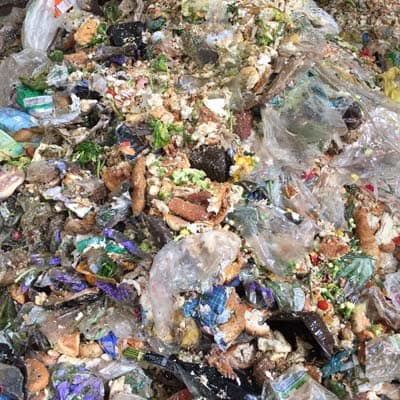
The call for improvement in reducing contamination of green and food waste has come from the Organics Recycling Group at the Renewable Energy Association.
Association technical director, Jeremy Jacobs said currently far too much non-target material is ending up in green waste, the biggest contaminant being plastic.
Mr Jacobs told letsrecycle.com: “We are calling on local authorities to improve the situation. Operators are worried about rejecting loads because of the problems this can cause.
“At the moment, responsibility lies with the operators to clean the loads, but that costs them money. Local authorities need to do more to inform residents and increase consumer awareness. Councils have a duty of care and a responsibility to provide the right materials in the right bins.”
Despite calling for councils to take a more stringent role in regulating, Mr Jacobs said that some local authorities had been doing a good job to address contamination. He said a “two strikes and you’re out” policy had been successfully implemented by a number of authorities, which involves “officers checking bins and if it continues to be contaminated the bin gets a sticker and isn’t collected.”
Plastics
Mr Jacobs explained that a key problem is with plastics and that while processors seek to remove the material it can be hard to do so.
“Organics processors sell on material to agricultural companies and the plastics can up on the land, which we don’t want. Operators will do the best they can as it’s in their interest to protect their businesses and ensure quality supplies. But, it would be a considerable help if local authorities could provide uncontaminated organics.”
And, Mr Jacobs said the issue was not limited to green waste but “affects all waste streams across a wide range of feedstocks. We’ve seen it with paper and plastics to China, and certainly it is the case with UK farmers, they aren’t going to take any old rubbish.”
One example of a local authority which Mr Jacobs said was doing good work in improving the quality of collected organics is Buckinghamshire county council.
Buckinghamshire
When contacted by letsrecycle.com, a spokesperson from the council explained: “Being a two-tier authority area, effective collection of green waste in Buckinghamshire depends on close working between the county council as the waste disposal authority, and our four district councils as collection authorities.
“However, the key to maintaining the quality of our green waste lies in our relationship with the residents of Buckinghamshire. Good communication with residents ensures that they not only understand the practical requirements of recycling, but that they actually engage with the process in terms of the environmental benefits – which leads to reduced contamination when green waste is being disposed of.”
The spokesperson said the engagement is the focus of its upcoming campaign, ‘Fighting Food Waste in Bucks’.
“This campaign seeks to involve people in the ways we can reduce food wastage in the first place, as well as ensuring that the food waste we do produce is captured in the kerbside collection and goes into the anaerobic digestion process for green electricity generation.”
Budgets
Commenting on the concerns over organics quality, sector expert Charlie Trousdell of Charlie T Associates, agreed that more needs to be done to address quality.
He explained that in his view, in the past composters and local authorities had put effort into getting the right quality of organics and there was an improvement in public awareness of services.
However, over the last couple of years standards have slipped which has been blamed on cuts to local authority campaign budgets, Mr Trousdell claimed. As a result, he said plastics are becoming ‘more prevalent’ in organics.
“If we stop the public putting the plastics in it, it makes it easier for operators. Local authorities have a duty of care and need to make an effort to tackle the problem at HWRCs.”
Mr Trousdell said a number of local authorities are good at addressing the problem but this is not the case for all.
Tender
He continued: “They choose a cheaper tender which can decrease quality standards and this means there is more plastics than there should be. If we want the situation to improve it’s a two-fold approach – operators must reject loads if they aren’t good enough and local authorities need to do more to reduce plastics being put in.
“There’s never going to be 0% contamination. But most contracts are 5% contamination which works out as a lot of plastic.”
In terms of what can be done to tackle contamination, Mr Trousdell said: “The problem won’t be solved overnight. AD operators have made investments to deal with plastics. We now need more education to try to make the public aware. The time is right for a bit more of a campaign. People want to do the right thing, if we get the education thing right that would help – people just need to be reminded.”
Rural
Justin Dampney, of Eco Sustainable Solutions said although contamination is not an issue for the company itself, he is aware that the sector is facing a quality issue. “We are really fortunate that we’re in a rural council area – ours is very clean.”
Mr Dampney added: “But I know it is a problem and it is at a lot of other sites. I’ve seen it myself. Inner city is where you see the problem more, from what I’ve seen and people who live in rural areas seem to care more. The most cost effective way is to educate people not to contaminate the organics. Contamination is very damaging for the industry.”
Gill Galagher, business relationship manager at food waste and cooking oil recycler Olleco, confirmed contamination is one of the main problems the company faces.
She said: “We mainly collect from the hospitality and food waste industry. Contamination is one of the main issues and the other is overweight bins.
“We accept packaging so we do allow 10% packaging/contamination, however this is stripped out in the AD process.”
“AD operators can look at how they can work with local authorities to use biodegradable bags for example.”
Lee Marshall, chief executive
LARAC

Ms Gallagher added: “Encouraging consumers not to contaminate organics is an ongoing challenge. I agree that it is an issue with food waste but we have the technology to remove the plastics, so it’s not completely damning. Glass and metal are more of an issue.”
LARAC
Giving a local authority perspective in regards to concerns raised over organics quality, LARAC’s chief executive officer, Lee Marshall, said that councils are already doing a lot in terms of communication with householders.
Mr Marshall said: “There’s only so much they can do. If people still choose not to do it, there’s not much more councils can do to change their behaviour.
“There’s a role for AD operators to support councils. It’s not always the easiest to know what the processors want.
“AD operators can look at how they can work with local authorities to use biodegradable bags for example. I think all local authorities are interested to get the materials to the quality wanted at the facilities and it’s in the councils’ interest to do that.”
And, Mr Marshall concluded: “Local authorities can only do so much. If they start to reject loads completely or stop collecting then you could the risk of turning people off recycling. There’s a fine balance in this.”
Related links
LARAC
Renewable Energy Association

Register for free to comment