

Glenn Stuart, head of waste management at Bury council, which moved to three weekly collections in October 2014 (see letsrecycle.com story), and Robin Baird, waste strategy coordinator at Falkirk council, which switched in May 2014 (see letsrecycle.com story), claimed that the move had also led to an increase in the volume of recyclable material collected.
Speaking at the Local Authority Recycling Advisory Committee (LARAC) Conference in Nottingham yesterday (October 14), the pair outlined their councils’ efforts to restrict residual waste capacity, whilst seeking to increase the volumes of recyclable materials collected from households.
In Bury, Mr Stuart explained that grey residual waste bins were switched from a fortnightly to a three-weekly rotation, while blue and green dry recycling bins are collected every three weeks rather than four – with two containers for commingled cans and plastic and one for paper and card. Mixed food and garden waste is collected fortnightly.
Finance
Mr Stuart added that there was a particular financial incentive for Bury to make the switch, with every tonne of waste that the council sends to landfill costing around £283.
“We are offering the same total bin capacity, but we shifted the emphasis from residual to recycling,” he said.

In the 11 months since the start of the new service, Mr Stuart claimed that residual waste tonnages have fallen by around 16.7% – with avoided disposal costs totalling around £860,000. The average recycling rate is expected to reach 54% – up from around 47% prior to the change.
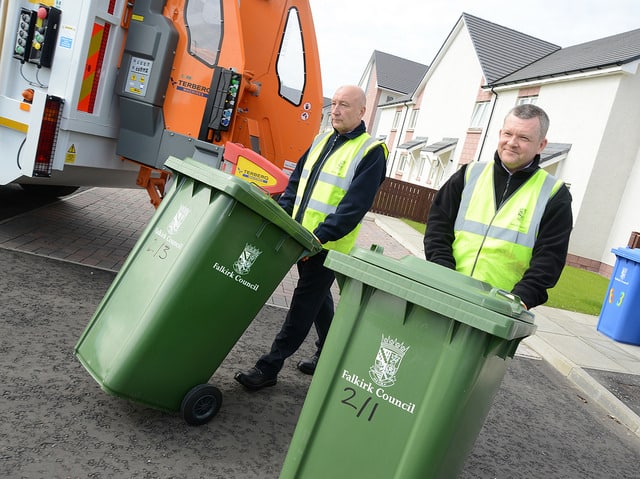
In Falkirk, Mr Baird explained that the council switched from a fortnightly rotation for residual waste to three-weekly, and is set to move towards four weekly collections in 2016. Food waste continues to be collected on a weekly basis, with dry recycling, textiles and garden waste collected fortnightly.
Falkirk
However, Mr Baird, the architect of Falkirk’s new system, expressed his frustration at the continued reference to ‘extended frequency collections’, and instead argued that the emphasis from council officers should be on ‘whole service provision’.
“I am frustrated that we are still talking about extended frequency,” he said. “Councils must look at the whole service, rather than the reduction in residual collection, it is the Daily Mail’s wet dream! If we can’t get it right how can we expect our communities to?”

Mr Baird revealed that the new service implemented in Falkirk had seen the percentage of recyclable material placed in residents’ residual waste bins drop from 60% to 50%, while the council is on course to achieve a landfill reduction saving of around £250,000.
Contamination
Critics of reduced frequency collection systems have questioned whether the measure is a suitable tool to increasing recycling rates, if it leads to higher contamination levels from non-recyclable materials at the kerbside.
David Rumble, head of strategic development at London-based waste firm Bywaters challenged the pair over contamination levels in recycling since the residual reduction, but both claimed that while full comparable data is not available, very few loads had been rejected by MRF contractors since the schemes came into effect.
Responding, Mr Stuart said: “We did a lot of work to make residents aware of the risks of disposing excess residual waste in the recycling bin. We have been very vigilant and that has resulted in only five partial loads being rejected as contaminated. It is very difficult to measure that against previous contamination levels, but we haven’t seen a noticeable increase in our contamination levels.”

Register for free to comment