


The figures are particularly significant because they come in the wake of the revised WEEE regulations which were introduced at the beginning of the year.
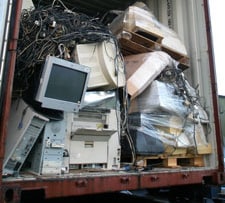
The 2014 data, which is available on the Environment Agency’s website, shows that a total of 120,088 tonnes of WEEE were collected during quarter two, with 112,503 tonnes collected during the first quarter of the year.
Changes to the WEEE regime in the UK were brought into effect in January 2014 as it was alleged that the old legislation was too costly for producers of electrical goods, who were obligated to fund the recycling of waste electricals.
The Department for Business, Innovation & Skills (BIS) has set a target to collect a total of 490,000 tonnes of WEEE in 2014 which means that a quarterly collection rate of 122,500 tonnes would be required, a target that the UK is currently falling short of.
Targets
Despite being behind the required collection rates needed to meet BIS’ overall targets for the year, the collection rate is broadly in line with the volume collected twelve months previously, when 233,453 tonnes of all categories of WEEE were collected.
Looking in detail at particular categories of WEEE, Display Equipment (mainly televisions) is one area where collection tonnages have fallen sharply, with 42,703 tonnes collected during the first six months of the year, around 11,000 tonnes lower than at the same point in 2013.
But, collections in other categories have increased in comparison compared to the same period 12 months earlier, in particular Cooling Appliances, which has seen tonnages collected jump by over 7,000 tonnes to 50,891 tonnes compared to January to June 2013.
However, BIS has reiterated its claim that the figures represent an encouraging performance for the sector, and are broadly in line with the expectation that tonnages would fall in some categories due to lighter products now being recovered.
A spokesman for the Department, said: “The Waste Electrical and Electronic Equipment (WEEE) collection figures for the first half of this year remain encouraging. The increased collections of cooling and small mixed WEEE compared to last year are welcome, and the drop in display collections appears to be in line with our expectations at the start of the year.”
| Q1 & 2 2013 | Q1 & 2 2014 | Change | Progress to 2014 Target | |
|---|---|---|---|---|
| Large Household Appliances | 75,498 | 76,943 | 1,445 | 44% |
| Small Household Appliances | 17,075 | 16,700 | -375 | 46% |
| IT and Telecomms Equipment | 16,660 | 17,252 | 592 | 51% |
| Consumer Equipment | 16,640 | 17,694 | 1,054 | 48% |
| Lighting Equipment | 2 | 9 | 7 | – |
| Electrical and Electronic Tools | 8,302 | 8,804 | 502 | 50% |
| Toys Leisure and Sports | 1,045 | 1,063 | 17 | 50% |
| Medical Devices | 7 | 3 | -4 | 15% |
| Monitoring and Control Instruments | 24 | 38 | 15 | 65% |
| Automatic Dispensers | 0 | 1 | 0 | 28% |
| Display Equipment | 53,984 | 42,703 | -11,280 | 55% |
| Cooling Appliances Containing Refrigerants | 43,807 | 50,891 | 7,084 | 46% |
| Gas Discharge Lamps and LED Light Sources | 409 | 491 | 82 | 58% |
| Photovaltaic Panels | 0 | 0 | 0 | – |
| Total | 233,453 | 232,592 | -862 | 47% |
LDA
One area were concerns have been raised is in Large Domestic Appliances, which despite collection rates being higher than during the same period in 2013, is still below the target collection rate for 2014. Currently only around 44% of the overall collection obligation for 2014 has been met with a shortfall of around 4,400 tonnes having opened up during the first six months of the year.
Should a collection target be missed for any particular category of WEEE, producers will be liable, through their compliance schemes, to fund the gap in collection by paying a ‘compliance fee’.
Overall the WEEE sector has collected just under half (47%) of its overall tonnage obligation for the year, but according to Dr Philip Morton, chief executive of WEEE compliance scheme Repic, collection rates are likely to be higher in the second half of the year than in the first.
Activity
Speaking to letsrecycle.com, he said: “We are half way through the year and although it is not quite linear, usually the second six months heralds the most collection of WEEE. If we are talking about activity that has gone on in the past we are probably about 2% down on 2013, but that is to be expected.
“What the new system means is that any WEEE arisings will always be dealt with. If we are not meeting the targets that mean that the WEEE is not arising. Overall it is a good system, as it means that anything that is a cost for a local authority or a retailer will be dealt with by a producer compliance scheme.”
Funding
But, this view has been challenged by compliance scheme Electrolink, which claims that the new WEEE system offers little incentive to fund the necessary increase in the tonnage of WEEE collected needed to meet the targets.
Lynne Cullis, Electrolink’s chief operating officer, commented: “We have performed in line with the gradual downward trend which has seen tonnages decline. The issue is that the 2014 target is up on what we collected in 2013, and it currently looks like we are going to be short across all categories, despite an improvement on the Q1 figures.
“From where we sit the obvious question has to be: are the funds in the system for the UK to meet its target? If it was at the same levels as in previous years we would be meeting our targets. The compliance fee doesn’t appear to be creating a massive clamour for people to fund every tonne of WEEE that is available.”


Register for free to comment