


The livery is the first stage of an impetus to increase glass recycling and follows Berryman’s acquisition by Reuse Collections, a wholly owned subsidiary of Reuse Glass UK last November. A 1.3 million investment in colour sorting glass at Berryman’s London and South Kirby depots will also take place over the next two years.
Mick Keogh, managing director of Berryman, said that the thrust of the initiative is to collect more glass. “This is an exciting time for glass recycling as demand is high for all types. We could easily find markets for two times the 560,000 tonnes that were collected last year because the glass industry is using more glass as a result of its improved quality.”
The re-branding aims to ensure that as much recycled glass as possible goes back into glass manufacture. The vehicles will contain hoardings with promotional messages such as: “Recycling one glass bottle or jar saves enough energy to power your TV for one
-and-a-half hours”.
Berryman hopes that the initiative will improve the quality of service as the livery includes a freephone number to ring if bottle banks are found to be full, in which case they will be emptied within 24 hours.

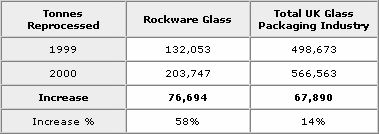
Reuse, which owns Berryman, has a contract to suply Rockware with cullet for its Knottingley plant. The table shows usage of cullet by Rockware in 1999 and 2000.
Mr Keogh added: “To hit targets and reach European standards, the number of bottle banks and kerbside schemes needs to increase in the UK. The target now must be to increase bottle bank density where practical, introduce and support kerbside schemes and recycle the thousands of tonnes of glass from the licensed trade which are currently going to landfill. All this will only be achieved in conjunction with intensive public awareness and education programmes.”
Reuse Glass UK operates what the company consider to be Europe’s most modern cullet treatment plant in Knottingley, West Yorkshire. Its full capacity of 200,000 tonnes is suppolied to Rockware and improved cullet quality has meant that Rockware has increased its use of recycled glass by 58 per cent in 2000.

Register for free to comment