


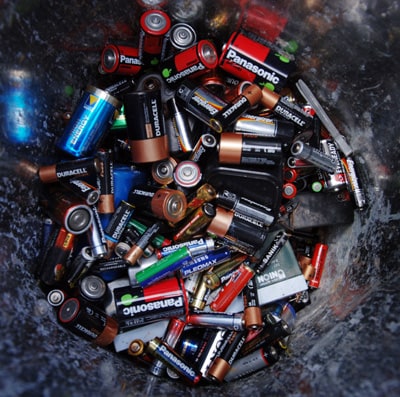
The 'Public Register of Battery Producers' shows that the compliance scheme has more than twice as many members as the scheme with the second largest membership – in numerical terms – which is Budget Pack with 60 members.
BatteryBack – a joint venture between WasteCare and Veolia ES – has 50 members, ERP has 32, REPIC's eBatt scheme has 29, the CCR REBAT scheme has 26 and DHL Battery Compliance has 25.
However, the list, which appears on the Environment Agency's National Packaging Waste Database, does not illustrate the total market size of each scheme's membership.
In particular, while ERP has a smaller number of members in relative terms, it can count Duracell – which has a 55% share of the UK portable battery market – among its membership (see letsrecycle.com story), as well as mobile phone producers such as Hutchison 3G, Sony Ericsson and Telefonica O2.
Meanwhile, BatteryBack's membership includes Tesco, ASDA, John Lewis and Morrisons, (see letsrecycle.com story) – meaning it will have access to the waste portable batteries which are expected to be collected via supermarkets under the Batteries Regulations' requirement for all larger battery retailers to offer free in-store takeback of waste batteries from February 2010.
Valpak
Despite this, Valpak's director of marketing, Duncan Simpson, told letsrecycle.com today (November 23) that he was “absolutely over-the-moon and delighted” about the number of producers the scheme had signed up.
And, he added: “What we're most delighted about is that it's a good tonnage and a good mix of producers and retailers.”
Mr Simpson explained that Valpak had done a lot of work in the lead up to the implementation of the regulations assessing the share of the market it would hope to win, and had used a combination of relationships with its existing customers for WEEE and packaging compliance and new contacts to build up its membership.
“Our reputation in producer compliance counts a long way in this,” he added.
ERP
Number of producers per scheme (as of 23/11/09)
-
Valpak 128
-
Budget Pack 60
-
BatteryBack 50
-
ERP 32
-
REPIC eBatt 29
-
CCR REBAT 26
-
DHL Battery Compliance 25
A spokeswoman for ERP said the scheme was also happy with the size of its membership, explaining that “we've got a good mix with lots of strong brands”.
And, she explained that the scheme was now focused on building its collection networks to source the waste batteries it would need to meet its member's obligations.
“We're building our network across the UK, our number of collection points is growing by the week,” she told letsrecycle.com, adding that ERP was “happy” that no one scheme had too big a share of the market.
Budget Pack
With the second most members, Budget Pack's membership includes Black & Decker, Bosch, Kodak, Fujifilm, BSkyB and Virgin Media to name a few.
The scheme's client services director, James Potten, said, “For us, it's not about the number of members but the relationship we have with each of them. We are working very closely with our 60 members to ensure we develop effective battery return systems to offset their recycling obligations.”
Breakdown
A breakdown of the producers listed on the register reveals that, of the 770 producers registered as of today (November 23), there are 724 who are obligated as portable battery manufacturers, with over half of these – 374 – classed as small producers.
This means they put less than a tonne of batteries onto the market each year, and, as such, only need to register with the Environment Agency and provide sales data, from January 2010, on both the amount and weight of batteries they have placed onto the market since May 2009.
There are 41 companies registered the with Department of Business, Innovation and Skills (BIS) as automotive battery producers, while 108 have registered as being obligated as an industrial battery manufacturer.
While many of these producers are also registered with a compliance scheme to meet their portable battery obligations, the system for industrial and automotive batteries is largely expected to operate as a “safety net”, with the vast majority of batteries in this sector already being recycled through established collection networks.
The number of registered producers is expected to increase as work by both schemes and the environment agencies to identify obligated manufacturers continues both in the lead-up to, and after, the regulations come into force on January 1 2010.


Register for free to comment