

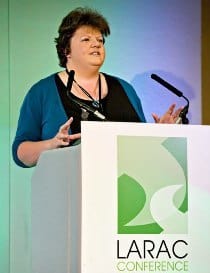
The event, which had UPM as its partner, was held on October 19-20, with Joy Blizzard, the chair of LARAC the Local Authority Recycling Advisory Committee setting the tone for the event which came as local authority budgets faced financial pressures.

Ms Blizzard said: This has not been an easy year for local authorities and some of you may have had colleagues made redundant.
She noted that the Prime Minister after the summer riots had urged individuals to take more responsibility and said that the government needed to make sure it took responsibility in ensuring the idea of the greenest government ever was delivered.
And, the LARAC chair warned that there had been a collectively lukewarm response to the waste review. England is now in in danger of being shown up by the other home nations.
The new recycling minister at Defra, Lord Taylor of Holbeach, gave the keynote address at the conference, outlining the governments proposal for more of a focus on business waste (see letsrecycle.com story). He was also tackled heavily by the audience on the 250 million fund for weekly waste collections (see letsrecycle.com story) .
Frontline
Lord Taylor sought to give a positive message to local authorities and said: I am delighted to be here to address you. You are the experts at working on the frontline of waste.
I am fortunate that I can build on the work done by my predecessor Lord Henley and the Waste Review. We all want an economy where waste is minimised, treated as a resource rather than disposed of.
Lord Taylor continued: Local authorities rank among our most important partners. You face one of the biggest challenges to drive waste up the waste hierarchy. And, tackling waste in the first place can mean less waste for business and consumers. Food waste is an excellent example of end to end thinking: addressing food waste at the top of the hierarchy means less for you to handle lower down.
Lord Taylor acknowledged that the Waste Review had not gone down well in some parts of the waste sector. We faced some criticism of the Waste Review. Local authorities have to be in the best position to determine what is best for their local areas and the Waste Review was designed to give you pointers, the evolution of waste policy will be in the hands of the practitioners.
Social media
The conference concluded with a forward-looking session on social media. Gerard Daring, business development director atKMP Digita, told delegates that social media is not something mystical, its just a few tools and rules that help us talk to our audience in a different way. It is an opportunity for business but a duty for the public sector and services and there is also a possibility that social media might save local authorities money.
Mr Daring commented that over 50% of the worlds population is under 30, that Facebook would be the worlds third largest country, and that some consider email pass.
Use social media, he urged, for distributing content, deliver customer service and for listening. Consider what you want to achieve, have a plan but be nimble and fast moving.
Alison Hook, e-communications editor at Coventry city council, set up a Facebook site for Coventry in 2009 and in January 2010 this had 527 followers but with the heavy snowfall that month, the number soared to 11,000. We used Facebook, she said, for a variety of messages such as school closures and updates on when bin collections would be made. There is no cost to use, just staff time.
The authority monitors the site and does not add controversial posts late in the afternoon, Ms Hook added.
“Social media isnt a fad, its a fundamental shift in the way we communicate”
Gabi Kaiser, Cherwell district council
Jack Linstead, communications officer for Warwickshire county council, described how the authority was effectively ahead of the game by launching an app. It had cost 9,000 and so far had worked out at 4.50 per download but was now reaching 15 downloads a week so the cost was coming down. Mr Linstead predicted that the day will come when your fridge will know what you have put in. It will question why did you use buy one, get one free, when you didnt eat it last week.
Gabi Kaiser, service development manager, Cherwell district council, said that social media isnt a fad, its a fundamental shift in the way we communicate. It is cheap, it is a way to get in touch with young adults and the media cannot put a spin on it.
She commented on Cherwells use of twitter. Tweet regularly, retweet and keep it fun and interesting.
Related Links
The presentations brought a positive reaction from delegates although when the question was asked as to what percentages of an authoritys residents were being contacted via social media, the speakers gave different figures, including as low as 1%.

Register for free to comment