


Polluters
And, it confirms one of the key rationales for the change by equating producers of packaging with ‘polluters’.
The Impact Assessment (IA), which was published alongside the EPR proposals from the Department for Environment, Food and Rural Affairs was published on 27 March is now awaiting scrutiny by the Regulatory Policy Committee.
The document notes that the past PRN/EPR system has kept costs low “compared to EU member states” but that without intervention, problems will persist.
Design
The proposals now include “placing the full net financial costs of managing household packaging waste onto producers, who are best placed to influence packaging design. This, says the document, is consistent with the ‘polluter pays’ principle.”
The IA notes: “The fees paid by producers should fund better and more consistent collections of packaging waste for recycling, and in turn encourage more domestic recycling and reprocessing and deliver overall system savings. Payments to LAs will take account of equity and regional considerations by looking at rurality and level of deprivation and performance expectations.”
Explaining the future compulsory measures on coffee cup recycling, the IA remarks: “Voluntary initiatives for recycling labels and fibre-based composite cup recycling exist but are insufficient.”
And, on labelling it says that variation in the design and information provided by voluntary labelling is confusing for consumers and needs to be standardised.
Finance
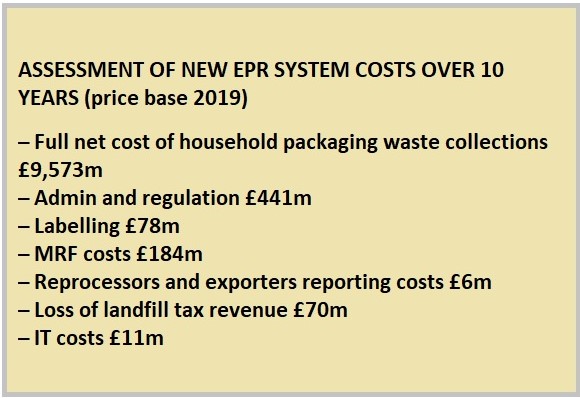
Financial implications over 10 years include:
- Local authorities will benefit by £9,573,000 from a transfer of costs for the collection, sorting, treatment and disposal of packaging waste to producers;
- there will be additional material sales profits by reprocessing and recycling industry (£105m);
- avoided residual disposal costs from diverting packaging waste from incineration and landfill treatment into recycling, including landfill tax savings (£281m); avoided greenhouse gas emissions from diverting waste from landfill and incineration to recycling (£440m).
Under the reformed system producers will still need to provide evidence of meeting their recycling obligations for all packaging. To facilitate this, as an interim measure, producers will continue to purchase recycling evidence (PRN/PERNs) on all packaging. Where producers are obligated to make payments to cover the full net cost of their household and binned packaging (packaging which is not recycled), they will be required to make an additional payment to bring their contribution for the management of household and binned packaging to full net cost.
The government, says the IA, “intends to consult further with stakeholders to gain their views on the best way to increase the efficiency of the PRN/PERN system, such as requiring more regular reporting of data and a more active role for Compliance Schemes, with the expectation that necessary changes will be made to the system in time for the reforms in this IA.”
Other key points include:
1. Current payments
For example, our current analysis suggests that producer payments under the current regulations would equate to around 7-11% of the full next costs of municipal (household and household-like) packaging waste collection and end-of-life treatment.
2. Brand owners
The obligations will fall mainly on brand owners; a new category of producer expected to cover several of the categories under the current scheme.
3. Online marketplace
Under EPR a new class of producers will become obligated, says the IA. “This relates to online marketplaces who will become obligated for filled packaging sold on the UK market through their platform/website by businesses based outside the UK. We estimate that this will lead to around 46 additional producers being obligated under EPR. This number has been arrived at by counting the number of online marketplaces that sell to the UK market. In order to exclude producers who are below the current de minimis threshold in this estimate, we have looked at the number of monthly site visits and have included only the number of producers with greater than 300,000 visits, assuming that these producers will surpass the de minimis threshold.”
Useful links
The Impact Assessment can be seen on the EPR page HERE.

Register for free to comment