

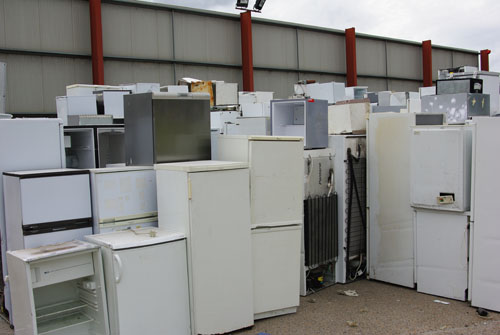
According to the data, a total of 291,055 tonnes of WEEE was collected from household sources from January to June 2016 – largely through the UK’s network of council-run civic amenity sites, known as designated collection facilities (DCFs).
However, the figures which are compiled by the Environment Agency, only indicate that a total of 271,768 tonnes of material was treated at WEEE processing plants, known as approved authorised treatment facilities (AATFs) for the six month period – a difference of around 20,000 tonnes.
The difference in the two figures is important as AATFs are responsible for issuing WEEE ‘evidence’ which is paid for by compliance schemes to demonstrate that they have funded the collection and recycling of sufficient tonnages of WEEE to meet the targets of their producer members.
Data
The Agency has said that it is seeking to understand how the large disparity in data has arisen, claiming that it is likely to have come about as a result of a delay in the submission of data from AATFs. ‘Immediate action’ will be taken to remedy the issue, the Agency has added.
“An internal procedural issue relating to the reporting of data for sites located within the jurisdiction of the devolved agencies has meant that data submitted for certain facilities has not been uploaded on to our IT system.”
Environment Agency
Commenting on the situation an Environment Agency spokesman said: “An AATF may have a number of facilities that are sited in different parts of the UK under the remit of different devolved authorities. They are only required to submit one return, however operators have submitted returns to both us and NRW [Natural Resources Wales]. Also, an internal procedural issue relating to the reporting of data for sites located within the jurisdiction of the devolved agencies has meant that data submitted for certain facilities has not been uploaded on to our IT system.
“Immediate action will be to identify the AATF returns that have not been uploaded correctly and to rectify this situation. Once validated, the UK data report for AATFs will be republished.”
The UK’s WEEE compliance schemes have been set a target to collect 544,341 tonnes of WEEE throughout 2016 – equating to a target of more than 272,000 tonnes for the first half of the year – meaning that progress towards the target is on course, despite the difference in data.
Defra
The Department for Environment, Food and Rural Affairs (Defra), which now oversees the UK’s WEEE regime, having taken over the brief from the Department for Business (BIS) in the spring, has welcomed the progress towards targets.
A spokesperson for the Department said: “Making the best use of our resources is important for our environment and our economy. These figures show great progress in the collection of waste electrical and electronic equipment for recycling and we remain on course to meet the annual collection targets.”
And, in a briefing note to stakeholders released last week, the Department has said that it will continue to encourage higher levels of collections through annual collection targets and “by the decision made by the Secretary of State regarding the possible approval and level of an annual Compliance fee payable by any Producer Compliance Schemes that falls short of its collection target”.
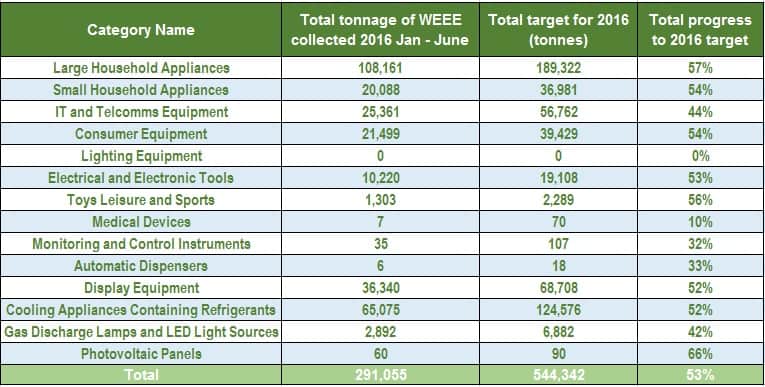
In particular a boost has been seen in large household appliances – which includes items such as washing machines and dishwashers – which is close to 60% towards its overall target rate for the year.
Tonnages
This is thought to have been aided by a drop in scrap metal prices – which it is claimed has seen more appliances recycled via AATFs, and therefore recorded in the WEEE system, rather than scrap metal sites.
Display equipment, for which a target of 68,708 tonnes has been set for 2016, also appears to be on track, with 36,340 tonnes of material having been collected during the first six months of the year.
Speaking to letsrecycle.com following the release of the figures, Philip Morton, chief executive of producer compliance scheme Repic, said: “We have done analysis and looked at the figures comparing the first half of 2015 against the whole year and compared that with 2016 and there are one or two things that are different.
“Category 1 [large household appliances] has achieved 57% of its target. That is understandable because of what has happened to scrap metal prices. They might have been able to move material 150 miles to make some money in the past, but now you’ll be lucky if you can move it 150 yards.
“Display tonnages have dropped – something which we were aware would be coming because of lightweighting of products. But, it is pretty much looking like it will be on target.”


Register for free to comment