
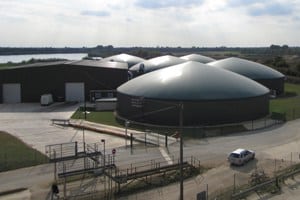
The anaerobic digestion (AD) sector has urged Defra not to relinquish all responsibility for food waste in England, despite its limited budget next year.

This follows a policy letter by new waste and recycling minister Dan Rogerson earlier this month, in which it was announced that Defra would be scaling back work on food waste and anaerobic digestion (see letsrecycle.com story).
Last week, food waste recycler ReFood UK launched its Vision 2020 roadmap report, in which it called for a landfill ban on food waste and a clearer strategy on food waste in England from Defra (see letsrecycle.com story).
ADBA
Now, the Anaerobic Digestion and Biogas Association (ADBA) has echoed ReFood UKs calls.
Chief executive of ADBA, Charlotte Morton, said: A clear strategy when it comes to waste policy and joined up thinking between the different agencies responsible for AD relevant policy, including bioenergy, transport, waste, food and farming would be a really positive step for the industry, helping new developers to secure feedstock contracts and therefore plant finance.
She added that, in the face of Defra scaling back its waste activities, the AD sector would have to step up to play an increasingly important role in developing technology, innovation and best practice to drive AD forward.
We have already seen progress in the UK when it comes to waste policy, with Scotland committed to banning organic waste to landfill by 2020 and Northern Ireland muting a similar plan. Defra, despite the reduction in resource, must show the same kind of ambition, recognising the huge economic and environmental gains from intervening to encourage food waste to be diverted from landfill to more sustainable treatment options such as AD.

‘Defra… must show the same kind of ambition, recognising the huge economic and environmental gains from intervening to encourage food waste to be diverted from landfill to more sustainable treatment options such as AD.’
Charlotte Morton, ADBA chief executive
Tamar
Dan Poulson, director of engineering and strategy at AD firm Tamar Energy, suggested that more leadership was needed on increasing food waste collections and introducing a landfill ban on organic waste in England. He added that as AD is still a growing industry, it is crucial that we are not faced with a government that relinquishes all responsibility.
He said that with increasing pressures on local authority budgets, it was important for the government to do more to encourage councils to change their waste collection methods, as only 70 councils in England currently offer a separate food waste collection service.
Mr Poulson said: The figures are more encouraging elsewhere in the United Kingdom, but the fact remains that there is a huge amount of potential feedstock from domestic, and also commercial and industrial settings, being wasted in landfill.
As such, he also said that Tamar supported a ban on organic waste going to landfill to force councils to find other methods of disposal, but admitted that this move looks unlikely in the short term.
Tamar aims to build a network of 40 AD plants in the UK by 2018 and while Mr Poulson said that it was the commercial sectors responsibility to ensure the necessary infrastructure is in place, he called for continued investment in AD in England.
Britains green-tech industry needs to get investment stability rapidly back on the agenda so renewables can play their role in stable, affordable energy, said Mr Poulson.
Biogen
Biogen which runs food waste AD plants in England and Wales and has plans for nine operational plants across the UK by 2017 also added to calls for a clearer strategy on food waste from Defra.
Echoing ReFood UKs report, chief executive of Biogen, Richard Barker, said: It remains with England to follow in the footsteps of Wales and Scotland and develop a clear vision for managing food waste.
Speaking to letsrecycle.com, Mr Barker said that separate collections of food waste needed to be rolled out at councils across England and that the government isnt thinking about this [food waste] as a strategic resource.
He said: The government has to get its head around the fact that we produce millions and millions of tonnes of waste as a resource, which the country could make a lot of money from. The fundamental issue we have is that there is a market failure around this resource which the private sector cannot just come in and fill. It is not just about investing, it is about recognising that market failures exist.
However, Mr Barker stopped short of fully supporting a landfill ban on food waste: I dont know that a landfill ban is the right necessarily because the infrastructure isnt really in place to put in place an effective ban.

Register for free to comment