

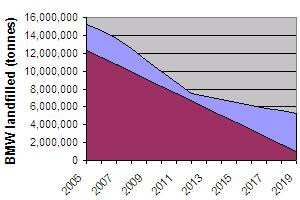
But, new figures for the financial year 2006/07 suggest councils are on course to meet landfill targets up to 2020 if current trends continue.

LATS was introduced in 2005 to make sure England meets it targets under the European Landfill Directive. The first target under the legislation requires the UK to reduce biodegradable waste sent to landfill to 75% of 1995 levels by 2010 or face financial penalties. The targets are 50% by 2013 and 35% by 2020.
However, the figures suggest that even if current trends continue for the reduction in landfilling, the period around 2013 could still prove difficult.
And, the Agency report suggested that 72% of disposal authorities in England will need to do more if the 2010 targets are to be hit.
It said: “Current indications are that unless there is a significant change in: a) reducing the amount of municipal waste produced, and b) increasing the amount of BMW diverted, trading alone is unlikely to help England meet all three of the Landfill Directive targets. Currently 88 out of 121 local authorities will need to take action to ensure they comply with the scheme in 2009/10. They will need to divert more BMW from landfill or purchase allowances to ensure they comply.”
Six authorities were predicted by the Agency to have a surplus of at least 50,000 tonnes' allowances in 2009/10 if current landfill rates continue – Hampshire county council, the North London Waste Authority and the four city councils of Birmingham, Coventry, Sheffield and Westminster. All councils use incinerators for a substantial proportion of their residents' waste.
UK targets remain challenging and local authorities must continue the good work.
Barbara Young, Environment Agency
Four authorities were predicted to have a deficit of at least 50,000 tonnes in 2009/10 on current rates – the Manchester and Merseyside waste disposal authorities and the West London and Western Riverside waste authorities.
“Challenging”
Commenting on the report, Agency chief executive Barbara Young said England was 20% under its 2006/07 allowance level for landfilling biodegradable waste, and that overall councils needed to reduce biodegradable waste to landfill by 350,000 tonnes to meet the 2009/10 targets.
She continued: “England has made a great start towards meeting the first landfill directive target in 2010 but the UK targets remain challenging and local authorities must continue the good work.”
Defra Environment minister Joan Ruddock also welcomed the work carried out by councils to reduce waste and said: “I am pleased to see that local authorities have taken their responsibilities seriously and are on track to meet the 2010 target. However, there is no room for complacency and I will continue to work with local authorities to deliver further improvements.”
In 2006/07, 11.55 million tonnes of biodegradable municipal waste was sent to landfill, down by 800,000 tonnes on 2005/06.
Of England's 20 largest waste disposal authorities, Hampshire county council used just 25% of its allowance, while second place Nottingham county council used 67%. Merseyside Waste Disposal Authority used 96%, which was the highest of the large authorities followed by Surrey county council, which used 92%.
Extra allowances were traded by 17 local authorities, with 11 transactions carried out in 2006/07 at a price per allowance of £17.34. In 2005/06, four local authorities bought allowances for 2006/07 at a price per allowance of £21 per tonne, and three trades were made free-of-charge, which was put down to partnership agreements with neighbouring authorities.


Register for free to comment