

Previously, only three plants in operation in the UK had been confirmed as having met the criteria for R1 classification.
Achieving the accreditation means that the plants can be classed as a ‘recovery’ rather than a ‘disposal’ process for the treatment of waste.
Alongside the seven accredited operational plants given approval in 2015, a further six plants in design or under construction have been newly listed as having achieved ‘design status’ for R1 over the course of the year.
However, the data released to letsrecycle.com, which applies up to the end of November 2015, shows that some of the facilities which have been approved are listed as being in the ‘design’ stage, despite now being in operation – including Viridor’s Ardley EfW plant.
Additionally, some plants are counted more than once within the classification, due to having more than one EfW treatment line, including Suez’s Tees Valley EfW plant.
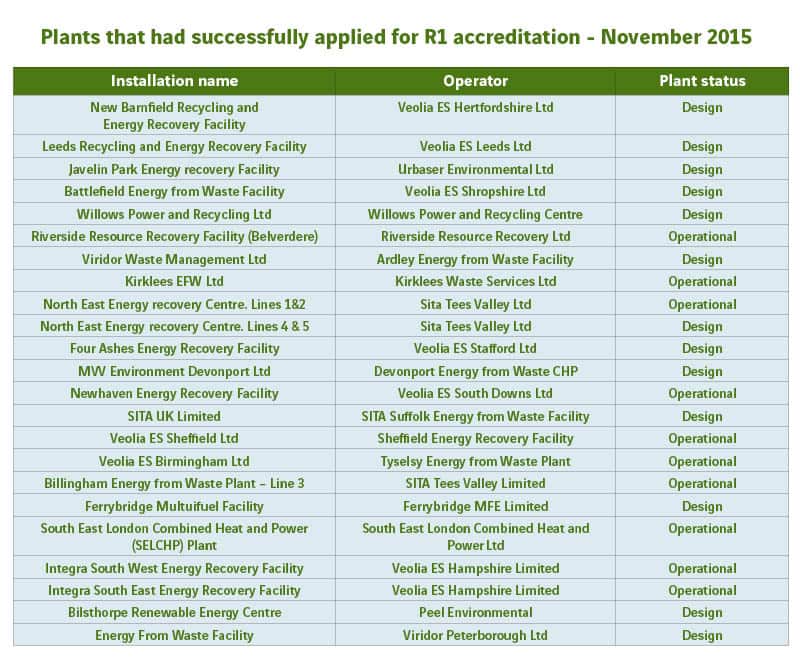
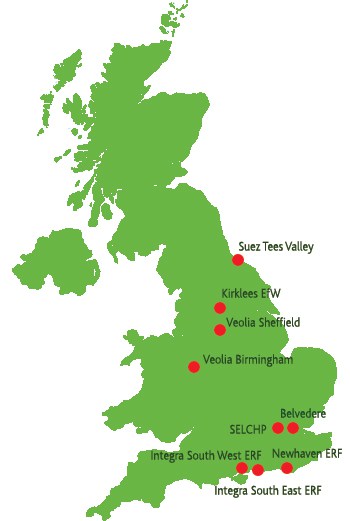
In total, there are now 23 facilities in England either in operation or planned that have successfully applied for or gained the accreditation. Of these facilities 10 are currently operating with R1 status.
Defra has also included Veolia’s New Barnfield facility and Norfolk’s Willows plant as having both achieved R1 design status on its list, despite the projects having been scrapped.
And, the Department suggests there are a further 29 EfW plants in England that could qualify for R1 status but have not yet applied.
In Wales, just one energy from waste plant has applied for and obtained R1 status – with another planned in ‘the near future’. A further three facilities would be likely to qualify but have not applied.
The latest figures suggest that there has been an increase in the number of facilities applying for R1 status throughout 2015. Documents published by the Department for Environment, Food and Rural Affairs in December 2014 indicated that, only three operational plants had achieved R1 status (see letsrecycle.com story).
| Environment Agency Guidance – How incinerators can be classed as energy recovery |
The criteria for achieving R1 status are set out in the EU Waste Framework Directive and act as a performance indicator for the level of energy recovered from waste. These are based on factors including the energy produced by a plant and the energy contained in the waste and determine whether a plant can operate as a ‘disposal’ or ‘recovery’ process.
Packaging
Since early 2015 EfW facilities are required to be R1 compliant in order to issue packaging recovery notes – which can be purchased to cover both the recovery and general requirements of producers under the packaging waste regime.
As many of the UK’s EfW plants had not sought to achieve R1 accreditation just half of the 500,000 tonne recovery packaging obligation had been fulfilled by the end of 2015 – with producers buying up paper and wood PRNs to meet the expected shortfall (see letsrecycle.com story).
However with a number of new domestic EfW facilities coming online between now and 2019, and PRN prices soaring in the wake of demand, the latest figures would fit with industry speculation that more operators are now applying for accreditation.
Defra
The number of plants achieving R1 status came to light this week after Defra launched a consultation seeking views on adding a Climate Correction Factor into the R1 formula, which aims to create a ‘level playing field’ between incinerators operating in warm climates in southern Europe and cold climates in the north – where energy from waste is produced more efficiently.
The Department claims that the changes will have ‘little or no impact to producers and operators in England and Wales’ and seeks to redress an imbalance that largely affects EfW plants in southern Europe.

Register for free to comment