

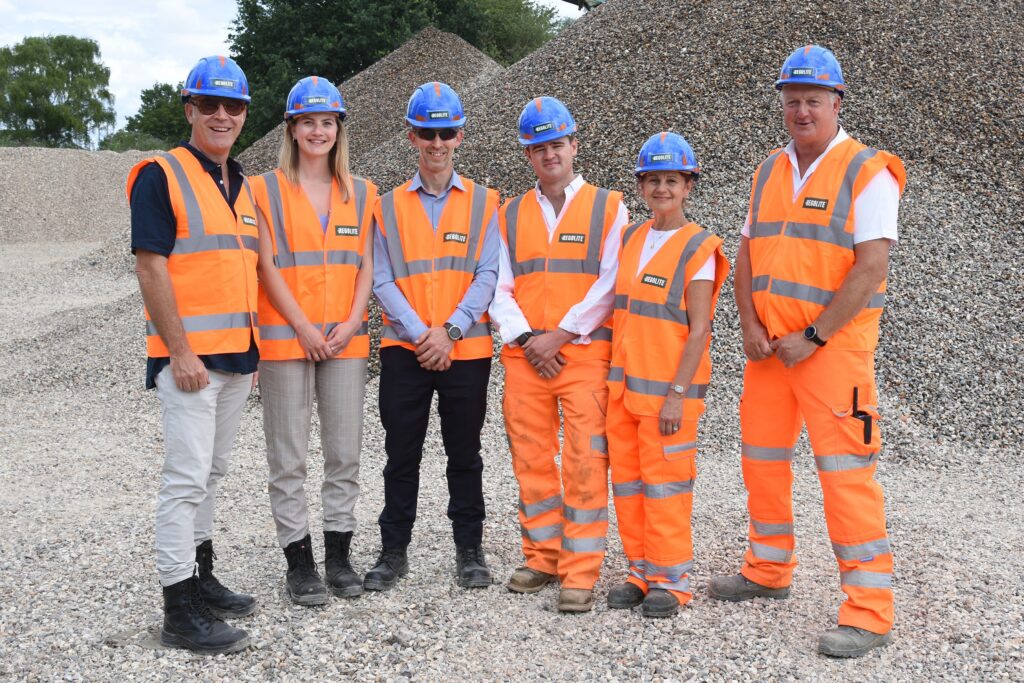
The new company, Regolite, follows a £2.6 million investment to upgrade an existing mineral processing plant at Grundon Sand and Gravel’s Kennetholme Quarry near Thatcham, Berkshire.
The investment has included the installation of a closed-loop water management and filter press system, alongside infrastructure works at the site.
The facility was officially opened recently by Grundon chairman Neil Grundon and Ben Maclean, director of DTE.
Maclean commented: “Regolite is a perfect example of the circular economy in action, as we are able to collect waste soils and stones from our clients’ sites, process it into usable recycled products, and offer it back to the same site/client as a high quality, low carbon alternative to primary virgin materials.
“Effectively the waste that comes out of the site in the first place, then becomes part of future construction and development.”
120k tonnes capacity expected
Regolite will receive non-hazardous waste from construction, earthworks, remediation and development projects at Kennetholme.
Materials including soil and stone are processed through the site’s wash plant, which removes dirt and silt before the recycled materials are graded into single sizes.
The resulting products include soft sand, sharp sand, 10mm stone, 20mm stone and 40mm stone, which will then be available for sale.
Andy Bright, General Manager – Aggregates at Grundon Sand and Gravel and a Director of Regolite, added: “Giving our customers the option of choosing recycled aggregates has been one of our long-term goals and we are delighted that the partnership with DTE has enabled us to achieve this.
“Regolite combines the expertise of two family businesses – the Grundons and the Macleans – mixing our innovative ideas and specialist skills to develop a product that both preserves precious natural resources and delivers environmental benefits too.”
Water used during the process is treated to remove silt and clay before being recycled back into the system.
The separated silt and clay is also passed through a filter press to extract further clean water, leaving a solid manufactured clay product with potential applications in earthworks and land reclamation.
The facility is expected to process around 120,000 tonnes of waste a year and produce an equivalent amount of recycled aggregate.
Grundon said that for every tonne of recycled aggregate used, around 1.4 tonnes of natural aggregate is saved.

Register for free to comment