


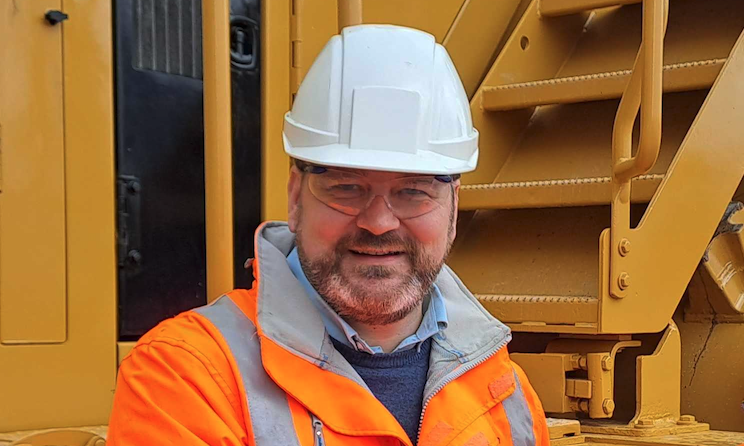
Following an industry roundtable on practical solutions, letsrecycle.com spoke to Finning UK & Ireland’s Jonathan Davies about what those challenges look like on the ground, and how sites can start to address them.
For waste and recycling operators, the current operating environment is challenging.
Costs are rising across the board – from fuel and energy to labour and maintenance – while at the same time, regulatory expectations and environmental standards continue to increase.
Davies explained: “It’s extremely challenging. Margins are tight, and operators are being pushed to do more with less resources.
“But we are also seeing there is real opportunity, particularly where there is a willingness to modernise.”
That opportunity, he suggested, lies in better use of data, improved asset utilisation and incremental operational changes.
‘Creeping inefficiencies’ in the waste sector
A report from Finning highlighted the increase of “creeping inefficiencies”– small, gradual issues that accumulate over time. On site, Davies said, these are rarely dramatic or obvious problems, and can take many forms:
- Underutilised machines combined with excessive idling
- Poor material flow across site layouts
- Equipment used outside its optimal application
- A reliance on reactive, rather than planned, maintenance
Collectively they can significantly reduce productivity, increase cost per tonne and place additional strain on both equipment and staff.
Davies added: “Poor practice becomes the norm, and once that happens, your performance benchmarks drop, and so does the scale of improvement you think is possible.”
For operators facing multiple competing priorities, knowing where to start can be difficult.
Davies suggested that the answer lies in going back to basics. Rather than trying to fix everything at once, he recommended focusing on three core metrics: availability, utilisation and reliability.
He explained: “If you understand what’s available to you, what you’re actually using, and the gap between the two, you can start to identify where the real opportunities are.”
From there, operators can begin to pinpoint bottlenecks, whether in loading, transport or processing, and build targeted action plans.
The role of AI and automation
Despite the growing availability of operational data, many sites still struggle to turn it into meaningful insight.
According to Davies, the issue is not access, but application: “The data is there in abundance. The challenge is time, confidence and clarity.”
Site teams are often focused on keeping operations running, with little capacity to analyse data in detail.
Recent developments in digital platforms are beginning to address this gap. More intuitive systems are making it easier for operators to access and interpret data, while new tools are helping translate information into actionable insight.
One emerging development is the use of AI assistants within data platforms, enabling users to query performance issues directly.
Davies added: “If a machine is overheating, for example, the system can help identify when it’s happening, what the likely cause is, and what actions to take.”
A learning curve for the sector
Looking ahead, the increasing use of AI and automation is likely to reshape operations, but not without challenges.
In the short term, Davies explained: “There will be benefits, but also pressure. There’s a learning curve, and change can feel disruptive.
“You’re not just automating a process, you’re redesigning how the whole site works.”
Over time, however, automation could reduce reliance on repetitive or hazardous tasks, allowing staff to focus on higher-value activities.
The greater challenge lies in integration. Waste sites are complex, dynamic environments, with variability in materials and frequent interaction between machines and people.
This includes rethinking layout, traffic management and how autonomous and manned equipment operate safely alongside each other.
Taking a people-first approach
While technology plays a growing role, Davies was clear that people remain central to site performance.
In a sector facing high staff turnover, motivation and engagement are critical. Beyond pay, he suggested that recognition, clarity of expectations and a sense of ownership can make a significant difference.
He said: “People want to feel valued. Acknowledgement of good performance goes a long way.
“If you create an environment where their input is valued, they will contribute. That creates ownership – not just of the machine, but of site performance.”
Hidden inefficiency: mismatched equipment
One often overlooked source of inefficiency is equipment mismatch. Davies said it is a common issue across sites, often driven by legacy decisions or a lack of reassessment over time.
He commented: “We see machines that are technically capable, but not optimally matched to the task.”
This can lead to higher fuel consumption, increased wear and maintenance costs, reduced availability and greater operator fatigue.
In some cases, machines are used in ways they were not designed for, such as equipment intended for lifting being used for continuous loading.
To address this, Davies advocated a shift in thinking. Rather than starting with the machine, operators should begin with the task.
“What are we trying to achieve?” he says. “Then identify the right tool, and then the right machine.”
This approach, commonly used in sectors such as demolition, can help ensure equipment is correctly specified and used efficiently.
One step operators can take now
For all the complexity, Davies’ advice for operators is simple: “Take a step back and understand how your machines are actually being used, not how you think they are being used.”
By starting with a high-level view of key data – fuel use, idle time, availability and utilisation – operators can identify quick wins without major investment.
He added: “It doesn’t need to be complicated. Break it down into small pieces, and you can start to drive meaningful improvements.”

Register for free to comment