


To counter this, the cross-party body said the mayor, Sadiq Khan, should increase efforts to reduce waste because he “has made it clear that he doesn’t support new incineration capacity”.
The report, called ‘Too Good To Waste’, highlighted challenges and made six recommendations to the Mayor of London, Sadiq Khan, on how to reduce waste and move towards a circular economy.
This included a recommendation to build a comprehensive network of repair facilities, lobby government to support higher standards for recycling in flats and encourage small businesses to prevent waste.
The London Assembly also called on Mr Khan to work with ReLondon to identify areas where non-domestic food waste collection could be improved.
At the same time, the group recognised that the mayor’s powers are limited as his remit only covers London’s waste authorities, meaning commercial waste is outside of his control.
Culture shift
The London Assembly scrutinises the activities of the mayor of London and has the power, with a two-thirds majority, to amend the mayor’s annual budget.
The Green Party’s Zack Polanski, chair of the London Assembly, said: “Our city needs a shift in culture and behaviour when it comes to managing waste. London needs to embrace a circular economy where waste is minimised, and it is the simplest and easiest choice to repair and reuse.
“As the saying goes, one person’s rubbish is another person’s treasure, and the circular economy is key to making sure more items are re-used or reconverted.”
Recycling challenge
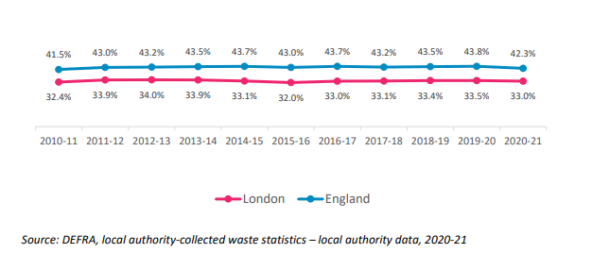
The report found that London’s current recycling rate is at 33% – the lowest in the country – and has stagnated since 2014/2015.
It noted London’s size can pose a challenge when increasing recycling rates as the capital consists of 33 local authorities, each of which collects their waste differently.
However, the London Assembly said a city such as London “could be doing more to help people overcome the barriers that make repair and reuse costly, when compared with the option of disposal and repurchase”.
This included making access to repair services easier and better advertising them.
Flats
On average, 50% of London’s population live in flats and in some boroughs this is as high as 80%, the report said.
While this has always been a difficult issue for councils, the London Assembly said the mayor could make further emphasis when approving local planning decisions to require better-planned facilities for recycling and waste collection, including food waste.
The report recommended that the mayor and ReLondon “should work with local authorities to identify areas where nondomestic food waste collection could be improved”.
Treatment
According to the document, London “burns” over half its waste for energy, sending the largest proportion of the total collected waste to incineration at 63%.

The report also stated that the capacity of landfills accepting London’s waste is expected to run out by 2026 and London’s waste bill was already in excess of £2 billion a year.
The impacts of incineration can be minimised with a circular economy and changes in consumption, it continued.
Useful links
Too Good To Waste -London Assembly March 2022



Register for free to comment