

Failure to meet the targets would result in a compliance fee having to be paid by some compliance schemes on behalf of their producer members as an alternative means of compliance.
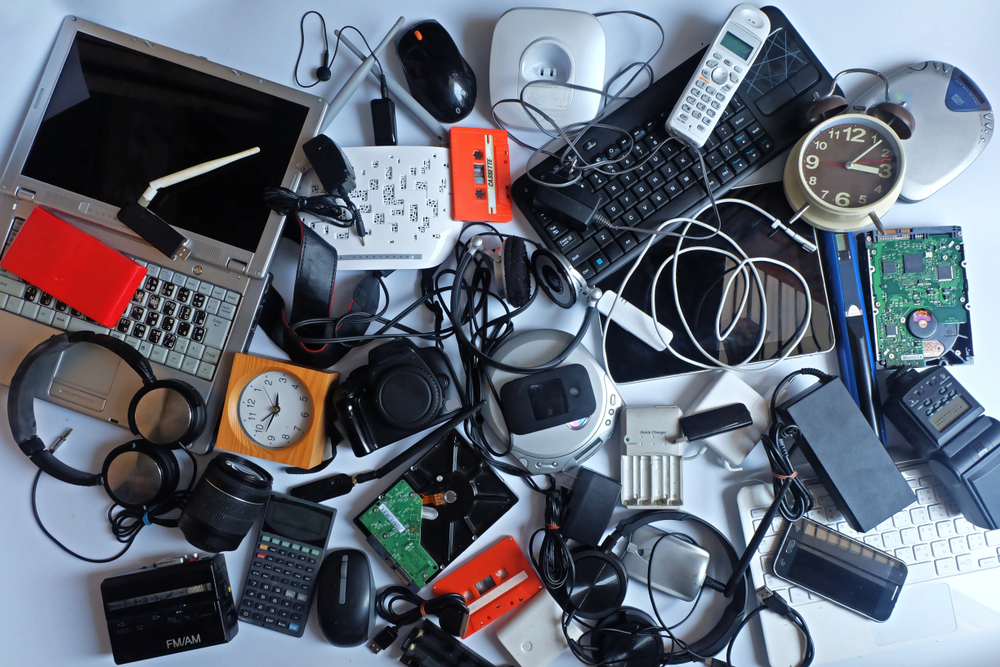
Figures on the volume of household WEEE collected for recycling were published by the Environment Agency on Monday (2 September) covering the second quarter of 2019 (April to June).
The figures show that a total of 121,776 tonnes of WEEE was collected during the second quarter of the year, on top of 122,403 tonnes recorded as having been collected during the first three months of 2019 (see letsrecycle.com story).
Targets for the collection of WEEE have been missed in consecutive years, with more than £10 million having been taken in ‘compliance fee’ money from schemes, on behalf of producers who have been unable to meet their targets in 2017 and 2018.
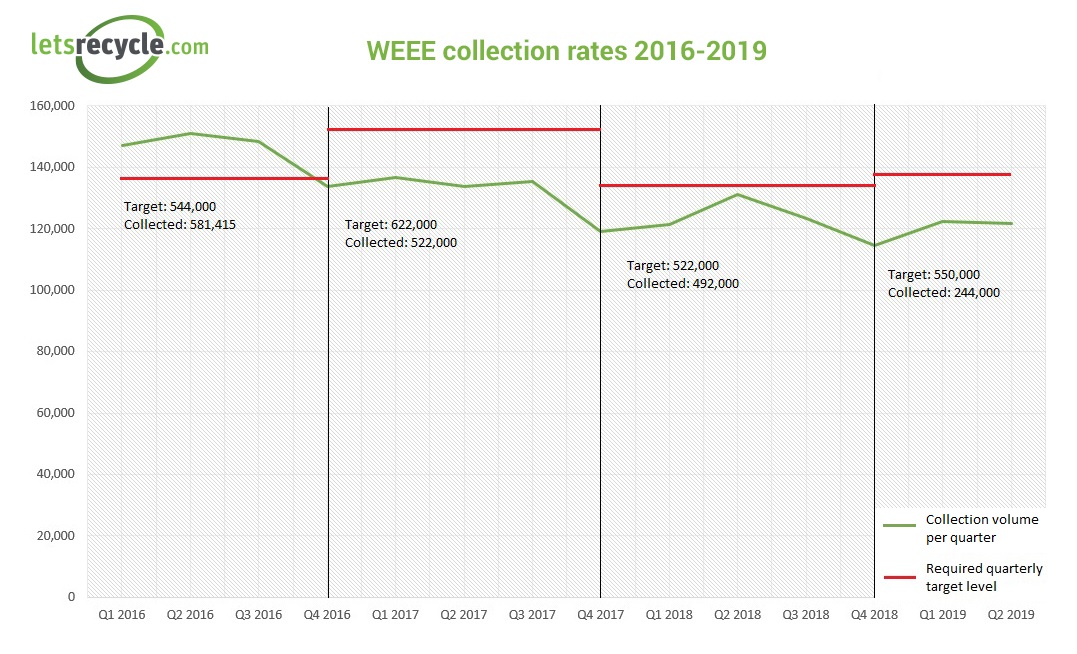
For 2019, there is an overall goal for compliance schemes to collect 550,577 tonnes of WEEE, an increase in tonnage of roughly 12% compared to the total amount of household WEEE collected in 2018. The higher collection rate is required for the UK to meet its EU WEEE Directive target.
However, the latest data suggests that if WEEE collections continue at their current levels through to the end of the year, it is possible that a shortfall of more than 60,000 tonnes could be recorded – raising the prospect of a significant compliance fee to be paid again by producers.
Small mixed WEEE
Small mixed WEEE is among the streams where there is a particular concern over the potential failure to meet the target, with around 41% of the year’s required tonnage having been collected. There are also forecast to be potential collection shorftalls in large domestic appliances and display equipment.

Commenting on the figures, John Redmayne, managing director at the European Recycling Platform (ERP) compliance scheme, said that meeting 2019 targets will be challenging for many schemes. Speaking to letsrecycle.com, he said: “The big challenge is in small mixed WEEE where we are 41% towards the target.”
Some schemes raised concerns over the increase in targets when they were initially set in March (see letsrecycle.com story) arguing that they were unlikely to be achievable, given trends in tonnages collected in recent years.
Compliance fee
Defra suggested that money collected through the WEEE compliance fee from previous years could contribute towards achieving a higher collections in 2019, through a series of projects on areas including communications.
However, much of the funding has yet to find its way through the system with the latest round of bidding for local authorities through the WEEE Fund opened last month (see letsrecycle.com story).
“Not surprisingly, with a significant upward shift in the target and a continuing similar decline in collection volumes the gap to the target is getting worryingly large.”
Mr Redmayne added: “The frustration for us is that when the targets were announced, this is exactly what we anticipated. Aspects that Defra thought might see increased collections this year have yet to get off the ground.
“Not surprisingly, with a significant upward shift in the target and a continuing similar decline in collection volumes the gap to the target is getting worryingly large.”
AATF Forum
Phil Conran, chair of the AATF Forum chair, which represents the WEEE reprocessing sector said the failure to meet WEEE targets for a third consecutive year would raise questions over whether the use of a compliance fee is the best means of increasing physical collections.
He said: “The Q2 numbers emphasise the detrimental effect that the current Compliance Fee system is having. If the UK is going to start to see significant increases in WEEE recycling, there must be an acceptance of the need for more investment in both collection and treatment and whilst we have the Compliance Fee is its current form, this will continue to be undermined.
“But, we recognise that the Regulations are under review and we look forward to contributing to their development.”
WEEE Conference
25 September, Lord’s Cricket Ground, London
Hear from expert speakers discussing issues facing the UK’s WEEE sector – including collection targets, regulation on POPs and treatment standards.
www.weeeconference.com


Still all talk about recycling but nothing on re-use, where does re-use sit in the WEEE Directive these day, seems to be long forgotten?