

Andrew Bird, the chair of the Local Authority Recycling Advisory Committee (LARAC) which represents council officers across the UK, has expressed ‘dismay’ over the reports, launched in recent weeks by the Renewable Energy Association (REA) on food waste, and by the Environmental Services Association (ESA) on delivery of waste services.

The ESA report accused councils of having waste service with “wide-spread duplication”, arguing that there were “significant scope for savings”, while the REA has argued that “in the majority of situations, food waste collected separately can save money for local authorities and businesses in the UK.”
Both the ESA and REA are private sector organisations with the ESA representing the UK’s major waste management companies while the REA represents composting and anaerobic digestion businesses. LARAC has called for industry to engage in a greater level of collaboration with local authorities on future reports.
REA: ‘Food waste’
REA’s report, launched in Parliament last week (23 May) called for food waste collections to be made mandatory across England, claiming that the move would ultimately lead to a ‘cost benefit’ to councils, due to a reduction in disposal costs (see letsrecycle.com story).
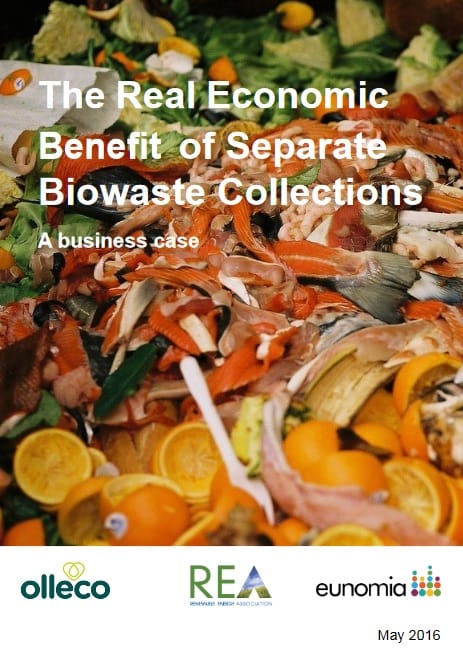
According to the REA the move would follow similar steps taken in Scotland – where food waste collections are mandatory for properties in non-rural areas – and Wales, where the Welsh Government recommends the separate collection of food waste as part of its non-binding Collections Blueprint.
Dr Nina Skorupska chief executive of the REA said: “With our 2020 recycling target fast approaching, now is the time for England to step forwards, where few businesses and only about half of local authorities are enjoying the benefits from collecting biowaste separately.”
However, unlike in England, both Scotland and Wales have offered financial backing for the introduction of separate food waste collections by councils, Wales through its Collaborative Change Fund and Scotland via a £5 million fund delivered by Zero Waste.
The issues of funding support, says LARAC, has not been brought to light by the REA in its report, nor has the difficulties in providing the services.
‘Self-serving’
Responding today, the local authority body dismissed the REA report as ‘self-serving’ and claims that it does not reflect the actual savings that might be realised by the introduction of separate food waste collections by councils.
Mr Bird, said: “The REA report calls for mandatory food waste collections in England on the back of modelling that shows the real savings come from changing residual frequency and reductions in food waste being produced in the first place, which are very optimistic to say the least.
“It also makes no mention of the huge financial support Welsh and Scottish Governments have made in supporting the introduction of food waste collections in those countries or the complications that having split collection and disposal roles in two tier areas brings to the costs allocations. So the ability to realise savings from food waste collections in England are much more limited than the report suggests.”
ESA: ‘Transfer’
LARAC has also criticised ESA’s report ‘Delivering Sustainable Growth’ report, which calls for the transfer of responsibility and funding of collection systems from local authorities to producers, as well as criticising the ‘patchwork’ of local authority waste management delivery.
In the foreword to the report, ESA chairman Peter Gerstrom claims that the waste industry has increased the UK’s recycling rate from ‘near zero’ in the early 1990s to ‘almost 45%’, but does not mention the contribution made by local authorities.
The ESA document calls for the work of councils in collecting recyclables to be taken away and instead given to “product supply chains”.
Myth
LARAC has claimed that the report ‘appears to peddle the myth that local authority collections are inefficient, a viewpoint that is outdated and shows a lack of understanding of council operations’.
And, the organisation has said it will engage with ESA to establish “exactly how they see the local authority role in household collections in the future”.
Mr Bird added: “Local authorities have risen to the challenge of making services more efficient in these hard times, whether delivered directly or through outsourcing. To suggest that they are not, or to call for a fundamental change in how local authorities operate without engaging with us first to see how it could work and what the challenges and possible consequences are, is disappointing and a missed opportunity.
“LARAC has shown itself to be willing to work closely with other parts of the sector to improve recycling and help others achieve their targets and we need more talking to local authorities instead of talking at them.”

Register for free to comment