



There is a lot of the talk currently about the circular economy. Although it is a concept that has been around for decades in one form or another, there seems to be a feeling that this is an idea whose time has come. There are a number of reasons why.
Perhaps in the first instance we can thank Ellen Macarthur, who has, through the Ellen Macarthur Foundation and working with Mackinsey, set out a compelling narrative and evidence base on the value that can be created through increasing circularity. In the UK WRAP has been at the forefront of promoting and developing knowledge of the circular economy. For example through their work with Green Alliance on quantifying the potential for job creation (see letsrecycle.com story). And also, increasingly, businesses large and small have been looking to exploit the opportunities afforded.
For those interested in understanding more, I recommend a quick read of three documents and attendance at the Circular Cities and Governments Conference we are holding at City Hall on Friday (more of that later).
Background
For those struggling to conceptualise the circular economy (and you are not alone), I think these documents will help to lift the veil. Ellen Macarthur Foundation’s Towards A Circular Economy: A Business Rationale for an Accelerated Transition, summarises the case and it helpfully articulates the answer to the question, “Why now?” It also discusses the RESOLVE framework, which is a great tool for policy makers and others who want to view the word through a circular economy lens.
Accenture Strategy’s Waste to Wealth is a book by Peter Lacy and Jakob Rutqvist. It identifies five separate circular economy business models (circular supplies, recycling and recovery, product life extension, sharing platforms, product as service) and 10 disruptive technologies. It is helpfully available as a downloadable summary.
Thirdly, the London Waste and Recycling Board has recently published the first part of the Circular Economy Route Map, London – The Circular Economy Capital: Towards a Circular Economy – Context and Opportunities. In this document, we look at how we can apply and accelerate the circular economy at the city level. Cities are important. For the first time in history more people on the earth live in cities, and by 2050 it is estimated that two thirds of the world’s population will live in cities. It will be cities and their population that will deliver the circular economy. And cities can, and often do, move faster and further than their national governments. For example just look at what the C40 cities programme, which brings together the worlds biggest cities, have done to catalyse action to reduce climate change, while national governments have historically struggled to reach agreements.
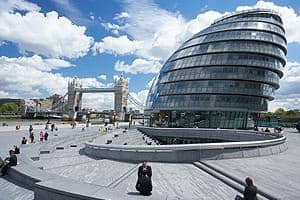
London
London’s has one of the worlds biggest financial centres, it has a huge educational establishment of global significance, it is the home to some of the worlds most important and influential media establishments, and hosts the national government. London is very well equipped to accelerate the circular economy. Crucially London is growing faster than at almost anytime in its history. The Greater London Authority estimates that by 2030 London will have grown from its current population of around 8.6 million people, to about 11 million. To accommodate those new two and a half million residents will require significant new infrastructure. Interestingly we are not proposing much more in terms of waste disposal capacity, and quite possibly, as we refine our understanding of the waste avoidance capabilities of the circular economy, we may think about less waste disposal capacity in future.
In The Circular Economy Capital we have identified five areas of initial focus; the built environment, food, textiles, electricals and plastics. We think that the circular economy represents a possibility to generate net annual benefits for London of at least £7 billion by 2036, and generate around 12,000 new jobs in the resource efficiency sector.
Other cities around the world are, like London, beginning to want to understand how the transition to a circular economy can benefit them. Like London, they want to understand what they can do as cities and regions to accelerate this transition.
Circular Cities Conference
LWARB and the GLA have organised a conference to help to further promote the activities that some of the leading cities are taking, and also some of the leading regions and governments. We will be hosting the deputy Mayors of London, Paris, and Amsterdam, as well as senior representative form New York and Copenhagen, as well as presentations from Scotland, Denmark and Northern France. In addition there will be contributions from Peter Lacy, blobal managing director for sustainability services of Accenture Strategy and Max Tellini, head of circular economy projects, Intesa Sanpaolo Group
If you are interested in understanding the circular economy and the power of cities, then you should attend. More over, it is free to attend – you just need to register.
I hope to see you there.

Register for free to comment