


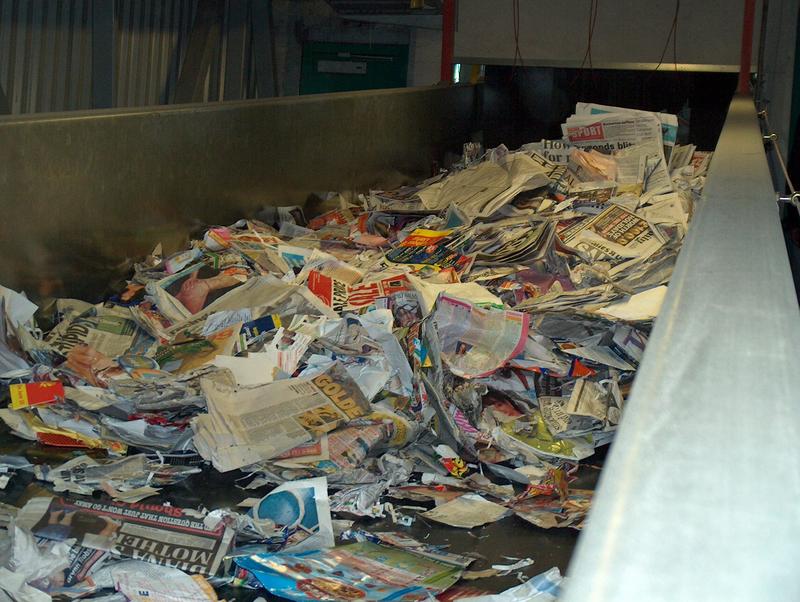
The reductions come after the closure of the Aylesford Newsprint mill in February and now waste management contractors have moved to reassure customers that they are finding markets for material but at the same time have cautioned that expectations will have to reduce.
Immediate price cuts for non-contracted material are being imposed by Palm Recycling which supplies the Palm Paper newsprint mill in Norfolk. The reductions have brought the general market price down and will affect tonnage previously handled by suppliers into the Aylesford mill.
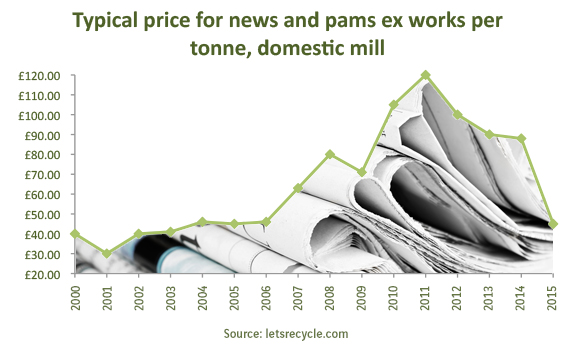 Since the sudden closure of the Aylesford mill on February 24, the sum paid by the UK’s main buyer of non-contracted or spot market material, Palm Recycling, has fallen to about £55-60 per tonne delivered or about £45 ex works, representing a reduction of £30 in one week. Palm Recycling supplies the Palm Paper mill in King’s Lynn.
The price fall is unprecedented during non-recessionary times – the last major downturn in the market was at the onset of the recession at the end of 2008 although prices recovered in 2009.
One paper sector expert said: “I would expect further price falls for loose newspapers and magazines and local authorities may well face lower income levels when contracts are renewed. A price of £35 for used newspapers would not surprise me.”
Palm Paper takes in about 500,000 tonnes of used newspapers and some magazines at King’s Lynn. It is also known to be keen to use higher quality material and had been importing some used newspapers from the continent.
About 700,000 tonnes of used newspapers is being put back into the UK market following the closure of Aylesford and the pre-announced January closure of one of the two machines at UPM in north Wales.
UPM
Little help to domestic sellers is available from UPM because the company already has sufficient contracted tonnage for its remaining UK machine, PM2, which consumes more than 360,000 tonnes of used newspapers to produce 300,000 tonnes of newsprint annually.
Simon Walker, UK head of recycled paper sales at UPM, explained: “The material coming into UPM here at Shotton is mostly on a contracted basis due to the recent change in the number of machines. Accordingly we have very limited demand for any extra material.”
Stora Enso
One newsprint mill across the Channel from the UK is run by Stora Enso at Langerbrugge in Belgium. Shropshire-based Newport Paper business, which has a supply arrangement with Stora Enso, said it would be buying additional tonnages over the next few months but purchases “would be selective and driven by quality and price, and to a degree haulage rates”.
Storage concerns
There is no storage crisis yet for used newspapers and magazines but there are expectations that the situation could worsen in April. Brokers who serve export markets as well waste management companies who also export are said to be in urgent talks with overseas buyers and are being swamped with offers of material.
The price achieved for export newspaper material is also falling and may even reduce to mixed paper prices and it will be this sum which will also have an impact on council budgets.
[testimonial id = “195” align=”right”]
Sector response
A pan-industry and local authority response to the impact of the Aylesford closure is being coordinated by Marcus Gover, director of the Waste & Resources Action Programme.
The Recycling Association is also involved in examining ways to help the tackle current difficulties. Simon Ellin, chief executive of the Recycling Association, which deals primarily with waste or recovered paper, said he would be speaking with Marcus Gover.
Mr Ellin noted: “I think this all needs to be split into short, medium and longer term responses. There will certainly be distress tonnages on the market in the next few weeks. In the longer term the world will find a balance as there is a global marketplace for paper and this is a small amount of tonnage relatively speaking. But, in the short term, there will be problems and we are probably going to have to store material while extra orders are turned on for export mills.”
Mr Ellin added: “The market is now a buyer’s market rather than a seller’s market and prices are reflecting this.”

Register for free to comment