

Proposals up for consideration include incentivising the reuse of materials through deposit schemes, giving manufacturers greater responsibility to make products ‘recyclable’ and extending work on end of waste criteria.
The Commission is also investigating whether there is an ‘optimum level of recycling’ beyond which it does not make economic sense to go, as well as suggesting that for some low quality material streams alternative disposal routes such as energy or recovery or landfill could be permissable.
Officials from a number of Commission departments, including Environment, Growth, Energy, trade and Taxation met to discuss the early outline of the plans for the revised circular economy package at the meeting in Brussels on Monday (February 16).
Ahead of the steering group meeting they were presented with series of questions relating to the challenges in promoting a circular economy, and some initial suggestions as to where the Commission might look to explore regarding future policies.
Proposals
Documents released to officials ahead of the meeting demonstrate the Commission’s view on reuse, as well as the likely focus on much of the legislation on producers.
On reuse, the Commission states: “Products which could be re-used are sometimes landfilled. Examples include in particular glass bottles, which could be recycled or re-used e.g. through a deposit system. Ideas to address this issue could include incentivsing re-use by counting it towards the recycling targets for certain materials (e.g. glass) in the waste review.”
The documents, produced by Secretary General Catherine Day, also outline the Commission view on the need to encourage high quality recycling.
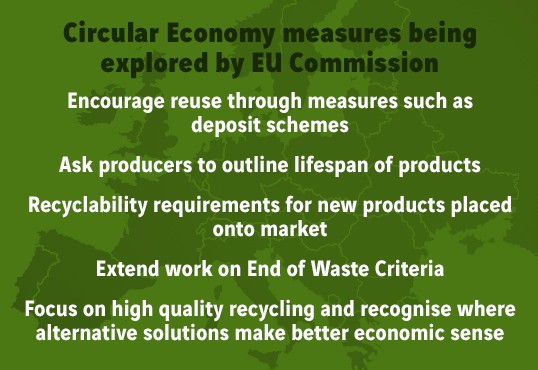 The document adds: “To reduce contamination rates, improved collection and sorting are essential. The EU framework should be paying attention to create the right incentives for high quality recycling. Moreover, the use of SRMs [secondary raw materials] derived from waste streams should be promoted where this makes economic sense. In order to develop appropriate measures, it would be useful to carry out analytical work to identify key problems in those markets which do not function well. This might also require recognition that for some materials (where it does not make economic sense to recycle), alternative waste disposal pathways should be allowed (such as energy recovery or indeed land-fill).”
Timetable
Officials were also given a proposed timetable as to when the Commission will look to complete the work, with 12 week consultation on the plans expected to take place between April and July, ahead of adoption of a new package towards the end of the year.
New proposals are being considered after the Commission dropped plans adopted by the former Environment Commissioner Janez Potocnik to update legislation around waste management and recycling (see letsrecycle.com story).
Dr Potocnik’s proposals included plans to increase targets for the recycling of municipal to 70% by 2030 and for higher targets for recycling packaging waste.
But, explaining the decision to look again at the proposals, Commission Vice President Frans Timmermans explained in December that a ‘broader, more ambitious plan’ would be drawn up in 2015, encompassing ‘the whole of the circular economy and not just waste legislation’.
In its accompanying documents for Monday’s meeting, the Commission explained that its aim for future policy is to: “move away from ‘end of pipe, one size fits all’ targets for individual waste streams. Our work will involve assessing the current waste situation in each Member State and whether current waste legislation is correctly implemented. If not, we will need to analyse where the problems lie (for example, is the legislation inappropriate, is there a lack of funding etc?)”

Register for free to comment