

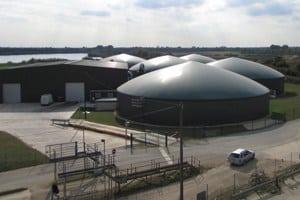
The anaerobic digestion market has reached a tipping point beyond which there is not currently enough food waste feedstock being collected to support the operations of new AD facilities coming online, according to a report by consultancy Eunomia.
Published today (June 30), the Anaerobic Digestion Market Update: Addressing the Feedstock Famine report claims that some operators are struggling to access sufficient feedstock at a level of gate fee which can support either new plant development or ongoing operation.

It is feared that is could cause consolidation in the sector in the near future.
As a result, Eunomia believes regulatory intervention such as requiring business and councils to collect and sort food waste is urgently needed to unlock further feedstock from the commercial and household sectors in order to maintain growth in the AD industry.
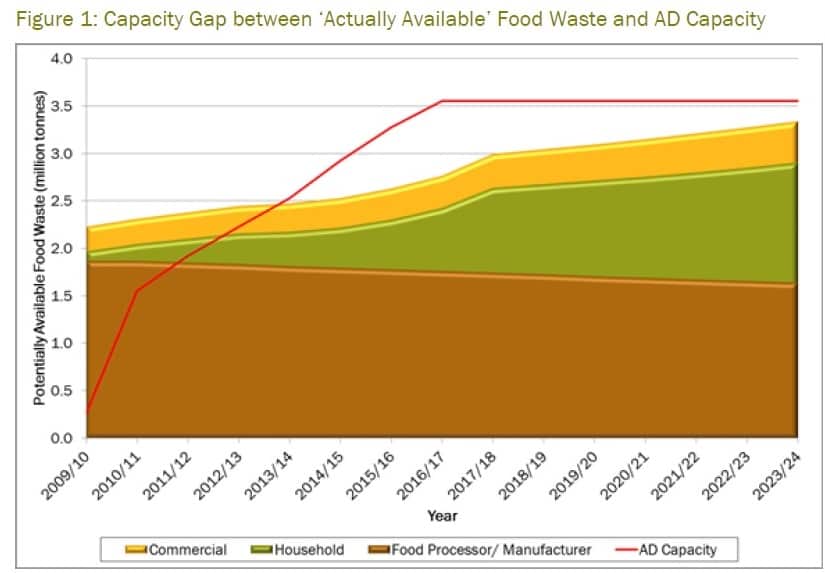
The reports findings suggest that there is a current oversupply of treatment capacity of 100,000 tonnes in 2013/14, which it forecasts will increase to 800,000 tonnes in 2016/17.
However, this is expected to then decrease again to an oversupply of capacity of 0.2 million tonnes by 2023/24 as collections of food waste grow but capacity remains the same.
Pricing
In order to encourage greater feedstock capture through household food waste collections, Eunomia recommends moving towards weight-based pricing, which it says is an attractive proposition for contractors offering residual and food waste collection services.
In addition, the consultancy suggests more waste collection services should be tendered collaboratively, with businesses joining together to reduce the costs of the service.
‘AD capacity designed to treat food waste is developing at a faster pace than food waste feedstock is being unlocked for separate collection. Market development and regulatory intervention is urgently needed to maintain growth in the sector and to ensure food waste is treated in line with the waste hierarchy.’
Adam Baddeley, Eunomia
Elsewhere, regarding regulatory intervention, the report calls for requirements for businesses in England and Wales to sort food waste at the source.
Such measures introduced in Scotland this year are already thought to have contributed to a 10-20% increase in food waste treatment in some areas (see letsrecycle.com story).
Furthermore, Eunomia recommends statutory requirements for all councils in England and Wales to provide separate household food waste collections, as well as tighter Environment Agency enforcement of the waste hierarchy, in order to boost food waste capture.
Nonetheless, the report states that it remains essential for the government, industry and councils to focus on waste prevention efforts to achieve the most cost effective and environmentally beneficial outcomes in terms of food waste generation and management.
Hierarchy
Part of the reason for lack of feedstock, Eunomia argues, is that while the landfill tax escalator has encouraged diversion of waste from landfill, it has not necessarily encouraged processing of food waste through AD, even though this is higher up the waste hierarchy than incineration.
In 2012, according to the report, 40% of the household waste sent for incineration may have comprised of food where no separate collection of food waste is in place.
The report states that while AD is higher than incineration on the waste hierarchy, many council waste contracts disincentivise food waste collection and AD.
It adds that the government has been very slow to enforce the hierarchy, while the Agencys interpretation of what the hierarchy requires in terms of food waste has so far appeared to be weak.
Lead author of the report, Eunomias Adam Baddeley, said: The report is underpinned by modelling which broadly quantifies the levels of source separated food waste, which is actually available across key sectors which generate food wastes.
Related Links
AD capacity designed to treat food waste is developing at a faster pace than food waste feedstock is being unlocked for separate collection. Market development and regulatory intervention is urgently needed to maintain growth in the sector and to ensure food waste is treated in line with the waste hierarchy.
Eunomias findings follow a report published in April by bioeconomy consultancy NNFCC, which also suggested that that the AD industry could be facing over-capacity, predicting that 5.5 million tonnes of food waste would be needed if all small and large-scale AD facilities currently under development come online by 2017 (see letsrecycle.com story).


Register for free to comment