

The warning came today (September 8) in the annual report on the Landfill Allowance Scheme Wales, published by Natural Resources Wales.
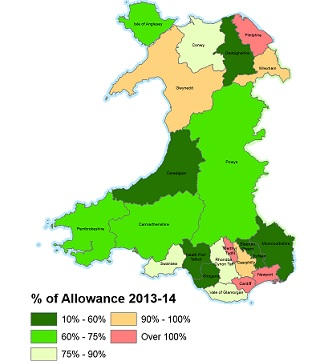
The 2013/14 report shows that Wales as a whole sent 345,022 tonnes of biodegradable waste to landfill compared to an overall allowance of 450,000 tonnes in the last financial year – 23% less than the allowance.
However, four councils exceeded their allowances altogether; the first time this has happened since the scheme was introduced. The four councils to exceed their allowances were: Cardiff, Flintshire, Merthyr Tydfil and Newport.
A further three councils – Caerphilly, Gwynedd and Wrexham – used over 90% of their allowances.
Infrastructure
The performance has been linked to a lack of residual waste treatment infrastructure in Wales, although this is being addressed in some parts of the country. For instance, under Prosiect Gwyrrd (Project Green) five councils in South Wales including Cardiff and Newport are developing an energy-from-waste facility in partnership with Viridor at Trident Park, due to open later this year (see letsrecycle.com story).
Commenting on the data, the Natural Resources Wales (previously the Environment Agency) states: “As a whole, local authorities have continued to make good progress in diverting BMW from landfill. It is essential that this progress is maintained in order to meet the future targets up to 2020.
“This will be particularly challenging for those local authorities that exceeded or were close to exceeding their 2013/14 individual allowances.”
LAS
The Landfill Allowance Scheme Wales was introduced in 2005/6 and is designed to reduce biodegradable waste sent to landfill in Wales in line with the EU Landfill Directive.
Since the scheme began in 2005/2006, Welsh councils have reduced the amount of biodegradable municipal waste sent to landfill by 59%.
Minister
Today’s data was welcomed by Welsh minister for Natural Resources, John Griffiths, who put a positive slant on the figures. The Welsh Government said it would work with those councils who exceeded their allowances to help them improve.
Mr Griffiths said: “I pleased to see that we are continuing to meet our targets to reduce the amount of biodegradable waste we send to landfill; Welsh councils sent 5% less to landfill compared to last year. It demonstrates that we are continuing to progress even as the targets become more challenging. We will continue to work with councils to support them to improve.
“Wales is leading the way in reducing the waste we sent to landfill and recycling, composting and reusing as much as possible. As well as helping councils to avoid landfill taxes, there is a clear environmental benefit. Biodegradable waste in landfill sites produces methane, which is 25 times more powerful than carbon dioxide as a greenhouse gas.”
Eight councils, Blaenau Gwent, Bridgend, Ceredigion, Denbighshire, Monmouthshire, Neath Port Talbot, Powys and Torfaen, used less that 70% of their allowances.
Ceri Davies, executive director for Natural Resources Wales, said: “It is great to see that local authorities are stepping up to meet this challenge. Less waste going to landfill shows that we are managing our resources better, which is good for the people, economy and environment of Wales.”

Register for free to comment