


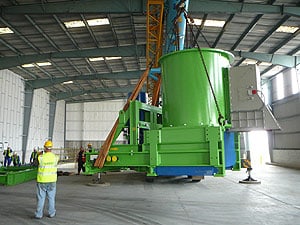
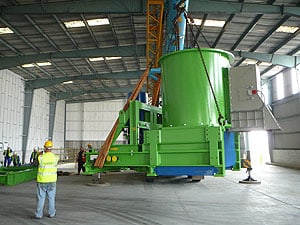
 The MeWa QZ 2000 WEEE disassembly unit being installed at the SWEEEP facility in Kent |
The installation of a new waste electrical and electronic equipment (WEEE) recycling plant in Sittingbourne, Kent, began on Friday, with the arrival of a German-made shredder.
Specialist WEEE Processing has taken delivery of a 40-tonne QZ 2000 automatic WEEE disassembly unit, the first component of its new MeWa mixed-WEEE recycling facility, which is set to be delivered by 22 lorries over the next four weeks. The full system is set to be up and running in time for full producer responsibility on WEEE to begin on July 1.
Patrick Watts, managing director of SWEEEP, said “SWEEEP is proud to be the first plant of this scale within the South of England. We will deliver fully WEEE directive compliant recycling at a rate of over 10 tonnes per hour.”
Commission priority on recycling strategy
Environment commissioner Stavros Dimas has said EU environment policy is delivering tangible results, but that global emissions of greenhouse gases are still rising.
The Commission has just published its annual review of its sixth environmental action plan (EAP), which states that the Thematic Strategy on the Prevention and Recycling of Waste (see letsrecycle.com story), one of seven strategies within the EAP, is being prioritised this year.
| Related links: |
In its review, the Commission noted that a green paper would be published this year to pave the way for a new Action Plan on sustainable consumption and production. It also said initiatives to strengthen Member States' compliance with the Waste Shipments Regulation would be launched.
Participation boost for Barnet's flat recycling scheme
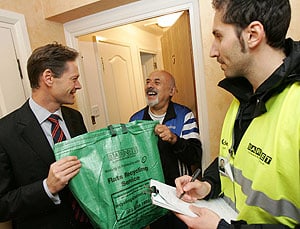 Cllr Matthew Offord (left) and Asterios Papageorgiou from Waste Watch (right) visiting Hendon resident Les Miller |
The London borough of Barnet has said an awareness campaign for its recycling scheme for flats has brought a 20 percentage point rise in participation.
More than 13,500 flats were visited during the winter campaign, with a survey revealing that the proportion of flats residents using their on-site recycling facilities increased from 51% to 71% after the campaign. Staff found that while most residents were aware they could recycle newspapers and magazines, fewer realized they could also recycle cans and glass in their communal recycling bins.
Cllr Matthew Offord, Barnet's cabinet member for environment and transport, said: “This is very encouraging news. Barnet is already one of London's top-performing boroughs for recycling and with the support of flats' residents we can hit new heights.
Researchers to compare recycled and primary aggregate impacts
Researchers at Imperial College, London and the Minerals Industry Research Organisation (MIRO) are to carry out a life cycle analysis project for aggregates.
The researchers have won an open tender from WRAP – the Waste and Resources Action Programme – to compare the environmental impact of primary and recycled aggregates for a variety of applications including use in concrete and asphalt. Midlands-based MIRO will work with Imperial College's Mining and Environmental Engineering Research Group on the project, which is to report its findings in September 2007.
Keith James, environmental advisor at WRAP, said of the project: “This will ensure a quality of reporting on the environmental profiles of various sources of aggregates, as well as on the comparative environmental impacts of the different disposal and recovery routes.”
Schools art project raises plastic recycling profile
 Young artists from Cabot Primary School and St Barnabas Primary School put some energy into plastic recycling in Bristol |
Pupils from two primary schools teamed up with community artist Lucy Rosewarne to raise the profile of plastic recycling in the St Pauls area of Bristol last month.
Six youngsters from Cabot Primary School and St Barnabas Primary School transformed the plastic bottle recycling bank at the Malcolm X Centre with eye-catching and informative art work. The recycling bank has since been featured as an exhibit on the St Pauls Arts Trail to encourage more people in the local area to recycle their plastic bottles.
Tim Anfield from the local environmental action organisation Grounds4Change, who organised the bottle bank art project, said: “It's easy for most of us to get into the habit of recycling plastic bottles. Rinse them, put them in a bag, then take them to the supermarket or another bottle bank when your passing. Recycling is simple common sense.”

Register for free to comment