


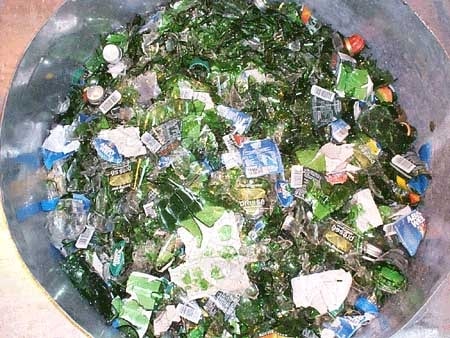
Councils should keep collecting glass commingled with other materials despite calls by British Glass to stop, a health and safety expert has advised.
In particular, he claimed that it was not uncommon for operatives to be exposed to 90-100 decibels – way above the 85 decibel limit imposed by law and much higher than noise levels experienced with commingled collections.
The comments came at an Environmental Services Association event in London entitled Designing Health and Safety into Procurement, and followed concerns by British Glass that increasingly less glass is being recycled into bottles, because it is collected commingled (see letsrecycle.com story).
Mr Jones, who is also director of risk management and compliance for Cory Environmental, said: “We should be looking at collections with reduced or eliminated glass to glass contact.
“I want to launch a campaign of my own because not commingling glass makes people go deaf,” he stressed.
Solutions
Mr Jones explained that the industry had been looking for at least two years at engineering solutions to reduce the noise of glass, but that as yet, there was nothing which could reduce volumes of glass smashing on glass to below a level where hearing protection was necessary.
And, while precautions such as ear-defence were available, he said that that raised other health and safety concerns by reducing operatives' awareness of what was going on around them.
He said: “While an operative wears earmuffs they could get hit by a lorry. Clearly it is an issue.”
Design
The comments foreshadow the publication of guidance by the Waste Industry Safety and Health Forum (WISH) on how best to manage noise exposure during kerbside glass collection – which is already considered a live issue by the HSE..
It is envisaged that a combination of the measures, covering working practices, glass and other waste collection strategies, and collection vehicle design, are likely to be most effective in minimising the noise exposure of workers
A statement on the HSE website said: “Workers carrying out kerbside collection of glass for recycling can be exposed to high levels of noise. The main source of noise appears to be the manual tipping of glass bottles, jars, etc. in to collection vehicle troughs, or in to wheeled bins which are used as intermediate collection receptacles. Levels of noise exposure will vary depending on factors such as the type of collection method used, rate of working and the type and mixture of recyclable materials.”
It is likely that workers' daily personal noise exposures will exceed 85 dB (the upper exposure action value of the Control of Noise at Work Regulations 2005, and in some cases daily personal noise exposures may be as high as 100 dB. The law requires that in these circumstances the employer must put in place technical and/or organisational measures to reduce noise exposure to the lowest reasonably practicable level,” it added.

Register for free to comment