


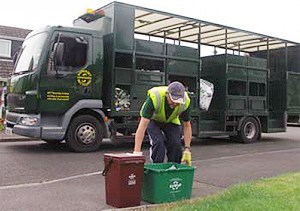
The report into different recycling systems suggests that they are more expensive when the costs of sorting in a materials recycling facility are taken into account.

And, it acknowledged that different schemes were needed in different areas – and that one type of scheme would always be cheaper – especially in areas such as cities.
Phillip Ward, director for local government services at WRAP, said: “The aim of this study is to provide a benchmark to help local authorities understand the cost of a good recycling system. The results will help the authorities understand how to limit the cost of the service to householders.
He added: “Collection scheme costs are sensitive to many things, such as the price which can be achieved for recycled material, and new technology means material sorted by MRFs is likely to improve in quality. This means it would be wrong to assume that one type of collection scheme is always going to be cheaper or produce better quality material than another.”
Services
The report looked at good practice in recycling services and modeled the relative costs and performance of these. It covered the costs of widely used kerbside collection systems involving kerbside sort, single stream co-mingled and two-stream partially commingled materials.
The study found, that in the current market, kerbside sort schemes were more cost-effective. And, contrary to the popular opinion that commingling was more successful in collecting recyclable materials, what determined how much recycling people did was the size of containers they had to put it in.
Earlier work by WRAP found that kerbside sort schemes achieve higher quality recyclable materials than co-mingled collections, as there is less risk of non-recyclables being included.
However the report acknowledged that different areas have different needs and there is no such thing as a one-size-fits all “best scheme”.
In fact, it said that co-mingled schemes may be the best option in some areas such as inner cities, where on street parking prevents kerbside sorting and there are lots of multi-occupancy houses where it is difficult to store multiple containers.
Mr Ward said: “For any recycling scheme to be successful, it needs to be easy to use, reliable, flexible and to manage health and safety risks. Above all it must be effectively communicated so householders are motivated to use it, buy in to the service, and are able to raise issues and problems knowing these will be dealt with.”

Register for free to comment