

This means most household WEEE must now be treated as hazardous unless it can be proved otherwise.
The few exceptions include large domestic appliances and some LED, halogen and incandescent lightbulbs and lamps.
In a statement directed at ‘environmental management’ and the WEEE recycling sector published on 8 June, the Environment Agency said: “We have updated this guide to reflect a revision of the Persistent Organic Pollutant Regulations in 2019.”
The Environment Agency statement explained: “Following a study to examine the presence of POPs in waste electrical and electronic equipment (WEEE), we have clarified the requirements for how you must manage WEEE.”
The updated guidance can now be read here.
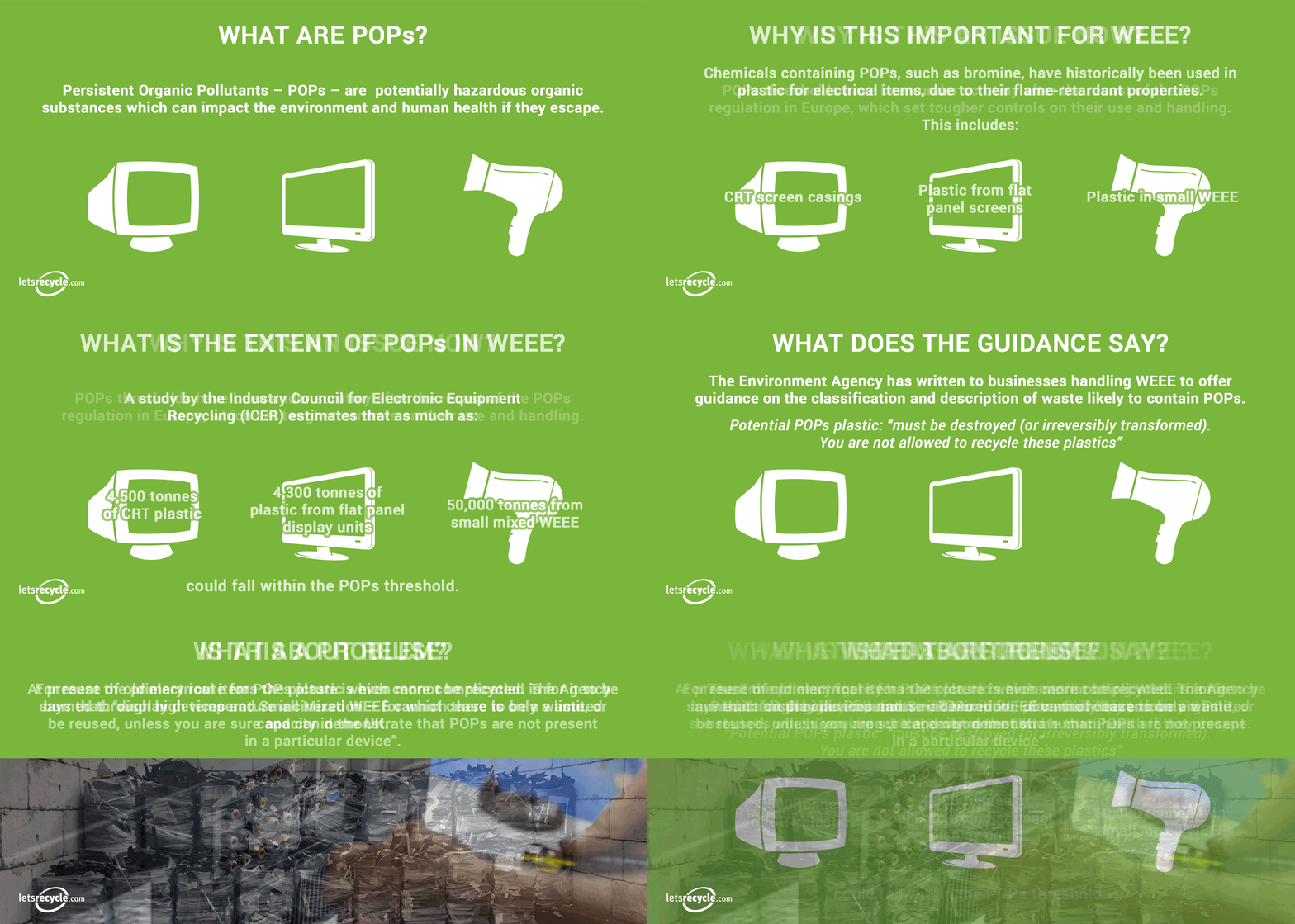
POPs
WEEE often has components that contain hazardous substances or POPs, the Environment Agency says.
These could include printed circuit boards; plastic casings, cables and other components; insulation foam; cooling agents; flame retardants; activated glass and screen phosphors; cathode ray tubes; capacitors; or Ni-Cd batteries.
The Environment Agency’s updated guidance reads: “If the levels of hazardous substances or POPs are over a certain amount the item will be classified as hazardous or POPs waste.
“If your WEEE is POPs waste you cannot reuse or recycle it.”
Exports
The guidance states WEEE can only be exported for reuse if it can be demonstrated each item has been checked to make sure it is not POPs waste. It must be demonstrated that the WEEE does not contain POPs above concentration limits in its printed circuit boards, cables and internal wiring or plastic components.
With changes looming in the classification of WEEE, in January the Environment Agency announced it was to allow an interim period to 31 July 2020 for recyclers to apply to vary their permits (see letsrecycle.com story).
Treatment
Phil Conran is chair of the AATF Forum, an informal body that represents the interests of the UK WEEE treatment sector. He believes the classifications will have significant ramifications for the collection and treatment of WEEE.
“These changes will have a significant impact on the WEEE sector”
Commenting on the impact of the updated guidance on the environmental management sector, he told letsrecycle.com: “These changes will have a significant impact on the WEEE sector. On the collection side, WEEE currently collected from businesses under a non-hazardous waste transfer note such as printers, computer base units and servers will now need to be consigned.
“And on the treatment side, reuse will be restricted and there will be significant cost implications in the disposal of POPs plastic waste streams.
“This will also go way beyond WEEE as cable plastic is now considered to be POPs waste.”
EAC
Meanwhile, the Environmental Audit Committee (EAC) is to hold its first public evidence session as part of its inquiry into electronic waste and the circular economy on 11 June.
The inquiry, relaunched on 13 March, is looking at how the UK can better deal with WEEE (see letsrecycle.com story).
During this session, the EAC will question representatives from organisations involved in collecting and processing WEEE, including LARAC, Material Change and the WEEE Scheme Forum.

Register for free to comment