



Defra packaging specialist Sarah Wooler, speaking yesterday (April 15) to an open conference of the Advisory Committee on Packaging in London, told the audience that the department, as part of its work to review producer responsibility measures, was looking to reduce the regulatory burden on smaller businesses and might exempt businesses below a 5 million turnover. This would exempt 1 in 9 producers there are currently 6,906 businesses obligated with the de minimis turnover at 2 million and 50 tonnes of packaging.
Ms Wooler said: “It is a top priority to take more of the small scale businesses out of the packaging regime. Government is determined that the UK is a place to grow their business.”

‘The cost of compliance is likely to increase though because it will become more difficult to collect greater amounts of packaging’
Bob Lisney, chairman ACP
The conference, chaired by ACP chairman Bob Lisney, also heard that minor changes will be made to the rules that govern the export PRN, known as a PERN. The Environment Agency will be more closely aligning the permitted generation of PERNs to factors such as how material was paid for, to better allow for contamination or material which was not recycled, rather than working on current assumed recycling levels.
And, reflecting on the potential for wholesale changes to the PRN system, Ms Wooler, said that while only small amendments were likely in the short-term, “we have to ask whether the PRN system would work if we get much more ambitious targets from Europe. The PRN system might get uncomfortable in the future.”
Priority
The conference included representatives from a number of obligated businesses, compliance schemes and packaging experts and aimed to better explain the PRN system and to outline some amendments that are in the pipeline.
At the conference Mr Lisney referred immediately to the PRN difficulties in 2013 when prices for glass evidence soared. “The ACP was asked to review the situation and make recommendations. This we did and I am pleased that the government have acted on those and have made an announcement based on the recommendations regarding revised glass packaging tonnages and targets.”
But, while he was pleased with the input of the supply chain in the discussions on glass, Mr Lisney said that it was found that the PRN system was not commonly understood and so the open conference was proposed with a further event likely in Scotland.
Mr Lisney said that there have been calls for the PRN system to be changed. “Despite these calls, I have not had any firm economic proposals sent to the ACP to consider. We have to remember that if we didn’t have the PRN system then we would have to have something else instead. Looking at other countries’ methods and costs of compliance we would have to have a very strong argument to even consider any fundamental changes.”
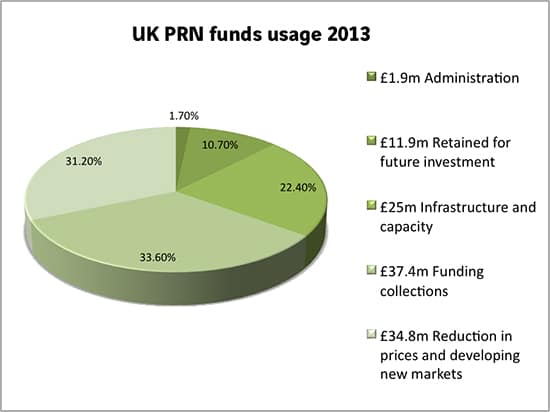
The chairman noted that the ACP’s view is that targets on packaging materials to be met by 2017 will ensure the UK meets its Directive targets. “That is not to say the system can’t be improved and if there are any reasonable amendments needed that can’t be handled within existing regulatory procedures, we will consider them and advise government accordingly. You will also be aware of the EU review of the waste directive which will undoubtedly consider packaging targets.”
Mr Lisney also warned that much of the “low-hanging fruit” in terms of packaging waste for recycling had been captured. “The cost of compliance is likely to increase though because it will become more difficult to collect greater amounts of packaging.”
Defra producer responsibility lead, Sarah Steeds, commented that the current system operates at “least cost to industry and consumers.” She also confirmed that the government has a “much better understanding” of what caused the spike in glass PRN prices and that they should now reduce.
“Some of the issues come about because of a lack of understanding of the PRN sytem and quite a number of issues which have been raised with us.”
Defra actions
Among areas Defra has worked on, Ms Steeds highlighted:
- Lack of level playing field between PRN and PERNs: working with EA to improve guidance which will be issued at the end of April.
- MRFs: environmental permitting will drive up quality.
- Poor performance by regulators (on environmental crime): an extra 5 million from the Budget, represents a 40% increase in expenditure by EA
- Insufficient recyclate from certain sectors: Solutions include work with WRAP and the soft drinks sector; work in the hospitality sector and Courtauld Three.
- Data reviews.
Ms Steeds added: “These are all important actions that are aimed at improving how the system works. We are looking further at a code of practice with the industry to “stabilise the PRN system”.
‘Designed by industry’
A history of the packaging waste system was given by Adrian Hawkes of the Valpak compliance scheme. Mr Hawkes described how the system developed in 1996 at low cost without central bureaucracy. “It was handed to industry to design but industry also had to meet the costs of recycling.”
He also explained how the UK system contains a mechanism to share out responsibiity, “a unique concept for the UK”. This means that, in percentage terms, the system gives 6% responsibility to raw material producers; 9% to converters; 37% to packer fillers; and 48% retail.
Mr Hawkes also showed a chart which revealed an increase in domestics plastics recycling activity, describing this as “showing a trend in the right direction”.
‘The system artificially favours exporters of UK waste as the processes involved have two entirely different cost bases’
Jessica Baker, Chase Plastics
And, he reflected on some of the things that the PRN system should and shouldn’t do not to artificially favour UK reprocessors over exporters or override world markets. But, the system should ensure even treatment of UK reprocessors and exporters.
Challenged by Jessica Baker of Chase Plastics that the existing system “artificially favours exporters of UK waste as the processes involved have two entirely different cost bases”. Mr Hawkes said while he agreed, “the system just needs to be fair”.
Reflecting on the ongoing debate over PERNs and PRNs, Sarah Wooler, policy consultant at Defra, said: “The UK government is a great supporter of free trade. Looking forward, the principle is to ensure that PRNs and PERNs going forward have a level playing field.”
Encouragement
The audience also heard a note of encouragement from Environment Agency packaging official Chris Groves. He said: “We have recovered just short of seven million tonnes and to me, from an environmental organisation, it is hugely successful to pull out of the waste bin 67-68% of all that packaging waste we are putting on the market each year.”
Mr Groves explained that the PERN changes will be linked to ensuring that there is an accurate reflection of the volume of material reprocessed overseas with additional checks. But the changes seem unlikely to satisfy the demand of some UK plastics recyclers who consider they are seriously disadvantaged by the export PERN believing it is easier and cheaper to obtain.
Environment
Ms Wooler also emphasised the importance of the environment in packaging terms. “Our ministers want to keep the environmental ambition.”
She also gave an assurance that a competition assessment will be carried out over the plan to increase the threshold for obligated businesses to 5 million. She was responding to some concerns expressed by Dick Searles, chief executive of the Packaging Federation, who said this could impact unfairly on some smaller businesses in the plastics packaging sector.
- Although Scotland, through Zero Waste Scotland and Valpak Consulting, is carrying out a study into the PRN system north of the border, any Scottish PRN system is unlikely in the short term. The ACP audience heard from Defra that any change would be a long way off as primary legislation would need amending.


Register for free to comment