

The biomass company was formed as a joint venture in March 2010 by the Stobart Group which has a substantial transport and logistics business, and AW Jenkinson, a well-established wood products and transport company. Stobart Group has a controlling share in the new business.
Speaking exclusively to letsrecycle.com, Stuart Rain, Stobart Biomass business manager, said that the company was seeing demand for material increasing month on month and is aiming to match the increasing demand for biomass within the UK and the rest of Europe through sourcing and supplying “sustainable biomass”. This consists primarily of low-grade waste timber, forest products and softwood logs as well as a number of other materials.
“There is a huge demand for recycled wood, pellets, virgin timber and for other biomass sources such as refuse derived fuel,” says Mr Rain. “A number of plants are built but there are a lot more being planned although securing planning permissions remains a challenge for the sector.”
He highlights the strength of the market and how it is being driven by legislation and government policy which is encouraging and attracting investment in renewable energy. And, Mr Rain points to estimates that some 40-50 million tonnes of material could be required for biomass plants annually in UK within the next few years, and 15 million tonnes of this is targeted at UK sources, with the rest imported.
Biomass categories
Five types of biomass are identified by Stobart Biomass:
1)Virgin fibre, including sawmill chip and forestry residues;
2)Recycled fibre such as re-used wood including packaging;
3)Commercial and industrial and civic amenity wood waste;
4)Refused derived fibre and solid recovered fibre which is processed and dried household waste;
5)Energy crops and non-UK imported biomass, such as rice husks, olive kernels and bagasse.
A crucial advantage in the marketplace for Stobart Biomass is its skills and experience in logistics.
Load factor
Stobart and AW Jenkinson as a pair have some 2,000 lorries running with a high load factor which is important to achieving efficiency and low costs. The importance of this is clear when taking into account the fact that about half of the cost of biomass fuel relates to transport and logistics.
The joint venture brings existing expertise in sourcing forest products and a capability to deliver, which is especially important when some power plants will need deliveries throughout the day and throughout the hour on a reliable and regular basis.
“By bringing these skills together,” says Mr Rain, “we can help make biomass plants a more bankable proposition as we can offer a secure supply contract for the developer.”
The sourcing of biomass is a key issue for the company. “We are always looking to expand the biomass sources available to us,” says Mr Rain.
Stobart Biomass is looking for new sources, for example in forestry from stumps and bark and also from the arboricultural sector. 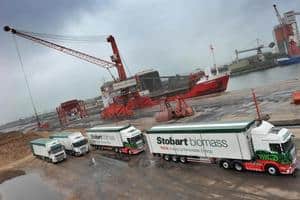
RDF and SRF
With a recognition that supplies of waste wood will soon be taken up, even if much more is diverted from landfill, the company is also looking outside of the traditional biomass sector to the producers of refused derived fuels (RDF) and solid recovered fuels (SRF).
This latter stream will come from drier material such as are generated through autoclave and similar processes: a number of such plants are now being operated or planned by waste management treatment companies.
Crops
Hopes are not high that a large amount of biomass crops will be grown on farms as questions remain over the amount of crops that farmers will be willing to grow for the market rather than growing wheat and other crops with higher values.
A further supply stream for Stobart Biomass could be through the importing of material although at present the company is a net exporter as it expands its source supplies in the UK.
Mr Rain explains that this is crucial because of the need to develop the biomass supply stream to give a “guarantee” to UK developers – in the meantime the export market is an outlet for surplus material.
The message is clear, however, for the UK biomass sector, Stobart Biomass intends to be a reliable supplier, providing that vital link between source and end-user.


Register for free to comment