

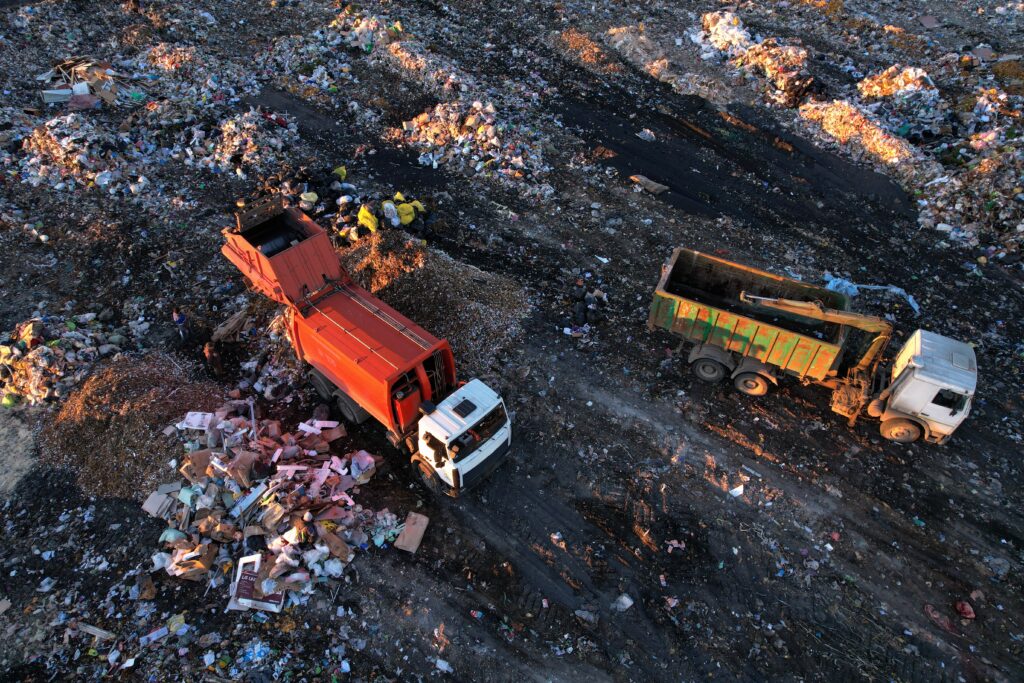
Data compiled from the Environment Agency’s (EA) Remaining Landfill Capacity reports showed that while some areas have added modest capacity, most of the country is seeing rapid reductions, putting pressure on councils, inflating disposal costs and heightening the risk of illegal waste activity.
Mark Hall, spokesperson for BusinessWaste.co.uk, said the findings highlighted the urgency of reform: “Landfill is disappearing faster than most people realise.
“Several UK regions are only a few years away from having no legal landfill space left, and this should be a wake-up call for us as a country to act more sustainably and recycle more, before it is too late.”
Shrinking landfill space across England
The South West is on course to become the first region in England to reach zero landfill capacity, potentially as soon as 2030.
Since 2020, the region has lost 45.1% of its landfill space, dropping from 29.6 million m³ to 16.2 million m³ in 2024, an average decline of more than 3.3 million m³ per year.
Much of the remaining space is concentrated in a handful of authorities.
- South Gloucestershire holds the largest volume at 4.26 million m³
- Wiltshire follows with 3.75 million m³
- North Somerset retains 2.38 million m³
Several major areas, including Bristol, Bath and North East Somerset, Stroud and Swindon, now have no active landfill capacity at all.
At current rates of depletion, it is likely that the South West has under five years of space left.
The West Midlands is close behind, having lost 40.9% of its capacity in the same five-year window.
Two regions added landfill volume
The East Midlands has seen the sharpest rise in landfill capacity, a 14.7% increase to 51.6 million m³ by 2024.
Much of this space is distributed across North West Leicestershire (11.86 million m³), Harborough (10.25 million m³), Bassetlaw (4.73 million m³), North Northamptonshire (5.42 million m³) and North Kesteven (4.13 million m³).
Meanwhile, the East of England has recorded a modest 0.3% increase, reaching 52.63 million m³.
South Cambridgeshire has the largest volume at 9.37 million m³, while other significant capacities lie in King’s Lynn & West Norfolk, Peterborough, Mid Suffolk and Central Bedfordshire.
Despite these increases, capacity in both regions is unevenly distributed, with many councils entirely without landfill space.
What happens when landfill runs out?
When a region reaches zero landfill capacity, councils will usually have to divert waste to sites in other parts of the country or rely more heavily on Energy from Waste (EfW) plants.
Losing a local landfill might mean that authorities no longer have immediate access to flexible disposal capacity for sudden surges in waste, such as after storms, flooding, major public events or large commercial clear-outs.
Rising disposal costs add to the challenge. The standard rate of Landfill Tax has increased from £96.70 per tonne in 2021 to £103.70 per tonne in 2024, putting further strain on already stretched local budgets.
Hall added: “If we don’t reduce what we throw away, and improve recycling and recovery systems, we will see more pressure on councils, who are already overstretched, as well as an even bigger increase in illegal waste dumping.”

Register for free to comment