

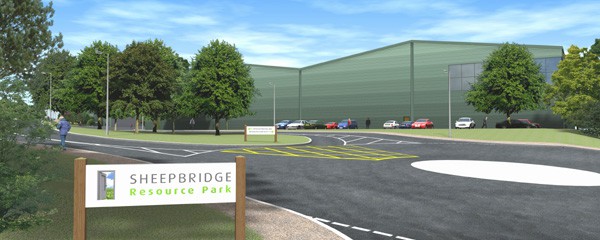

Under the agreement between the two firms, French-owned SITA is set to develop materials recycling facilities on four of the planned sites and also provide waste for the gasification process, while Cyclamax will operate the gasification plants.
Stuart Hayward-Higham, technical director at SITA UK, said: “This agreement is one of the first of its kind in the UK and is an important step forward in investing in the alternate treatment technologies to service the industrial and commercial waste market at a local level in the UK.”
“At SITA UK our goal is to offer our customers a service that allows them to reach a point where the majority of their waste materials can be reused, recycled or recovered for their energy content, in others words to give waste ‘a second life' wherever possible. Gasification is one of the many tools we can use to meet this goal and we are pleased to announce this agreement as another significant step forward in our plans,” he added.
The first four resource parks are set to be developed using batched gasification technology, a renewable energy technology distributed in the UK by waste-to-energy company Planet Advantage Limited – which is a subsidiary of Ascot Environmental Limited.
Parks
Four of the proposed resource parks – intended for sites at Dagenham, Avonmouth, Chesterfield and Derby – have already either received planning permission or are in the planning process, with the locations of the two additional facilities set to be announced in due course.
The first four facilities are expected to produce in excess of 45MW of electricity, which Cyclamax claims is sufficient to power over 85,000 homes.
Tony Watkins, managing director of Cyclamax, said: “By combining the expertise of both Cyclamax and SITA UK we feel we can offer localised, sustainable recycling and renewable energy solutions by productively diverting around 600,000 tonnes of waste away from landfill.
“Gasification technologies are particularly suited to delivering local community scale solutions and with investment levels of around £220M for the first four facilities, are economically competitive at this scale,” he added.
Proposals for the Chesterfield facility came under scrutiny in January this year when the local borough council's planning committee refused to back plans for the 60,000 tonnes-a-year capacity merchant facility. However, Cyclamax said the decision did not affect its plans (see letsrecycle.com story).
Gasification
The gasification process sees waste materials converted into a gas called synthesis gas – or ‘syngas' – that is made up of differing proportions of hydrogen, carbon monoxide and some methane.
In the case of gasification, which uses a combustion process, the oxygen levels are kept purposefully very low so that the combustion reaction only gets to the volatilisation stage where combustible gases are produced. The syngas generated can then be tapped off and used elsewhere for a multitude of applications.
Ascot, which has a contract with Cyclamax to provide ‘turnkey' gasification facilities at the first four of the proposed sites, opened its first batched gasification plant in Scotland last month at Dumfries through its subsidiary Scotgen (see letsrecycle.com story)

Subscribe for free