


However, while the plant is now accepting some waste, full operations at the site could still be up to a year away and the company is currently working with its insurers to fully assess the cost of the damage and shutdown.
When asked about the cost of the Frog Island fire, a spokesman for Shanks told letsrecycle.com: “Shanks is still in conversations with the insurer and until those have progressed further we will not be able to confirm a figure.”
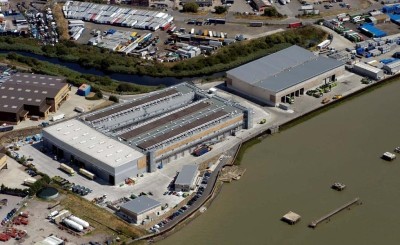
The plant is one of two 180,000 tonnes per year capacity MBT facilities serving a 25-year residual waste contract with the East London Waste Authority (ELWA), which includes the borough councils of Havering, Newham, Redbridge and Barking & Dagenham.
Since the Frog Island fire, waste from the ELWA has been sent to the other Shanks MBT facility at nearby Jenkins Lane, although some of the waste – estimated in October at around 4,000 tonnes per month – has also been sent to landfill (see letsrecycle.com story).
According to ELWA acting managing director Mark Ash, the Environment Agency has now granted Shanks permission to partially re-open the facility and begin accepting some of East London’s residual waste.
Speaking to letsrecycle.com, Mr Ash said: “The contractor has worked incredibly hard with regulatory bodies to start processing our waste again.
[testimonial id = “86” align=”right”]
“It has been partially open for just a couple of weeks. We are ramping it up now but we need to take it slowly. The easy thing is getting the material into the plant, but the trick will be getting it out the other end.”
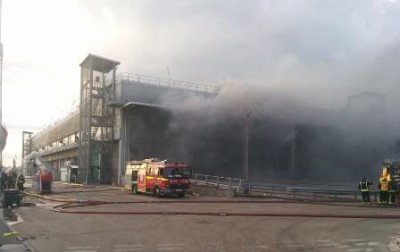
The MBT was fully out of action for almost three months after the fire, which affected 2,500 tonnes of household waste inside the reception hall of MBT line 1. At the height of the blaze, 12 fire engines and 81 firefighters and officers were at the scene on Creek Way and smoke could be seen for miles around (see letsrecycle.com story).
Landfill
Despite increased landfilling due to the Frog Island shutdown, Mr Ash said he expected landfill diversion from the ELWA contract with Shanks to be around 60% at the end of the year. Shanks’ contracted landfill diversion target from ELWA’s waste is 45%.
He said: “Diversion far exceeded contractual targets at the start of the year, so these targets will be met and exceeded. Nevertheless, our year-end budget costs will be increased which is where we are working at the moment with the loss adjustor.”
But although the plant is not currently expected to resume normal operations for up to another year, ELWA’s Mr Ash said all parties were working on fully reopening the plant sooner, if possible.
He said: “The contractor is looking at how to shorten that process. It may be possible – it just depends on the lead time of equipment. Everyone is keen that that time period is shortened.”
Shanks
According to Shanks’ interim financial results report for the six months ended September 30 2014, which was published last week (November 6), normal operations at Frog Island “are expected to take up to a year”.
The report states: “On 4 August 2014, there was a major fire at Frog Island, London, one of the two MBT facilities serving the ELWA contract. Despite the severity of the fire, we have been able to continue to serve the customer and to meet diversion targets. We have just received permission to bring Frog Island back into partial operation, while full reinstatement is expected to take up to a year. On the basis of insurance cover, we continue to forecast no material impact to trading profit as a result of the fire.”
On publication of the report, Shanks chief executive Peter Dilnot also spoke of “a challenging six months for Shanks due to an increasingly difficult Benelux solid waste market”.
He added: “However, we are confident that the actions we are taking to address these market pressures and improve our operational efficiency will support a stronger second half and a full year result in line with our revised expectations.
“Our three growth divisions are continuing to deliver against their strategic objectives and the Group is well positioned to deliver profitable growth over the longer term from our portfolio of market leading businesses.”


Register for free to comment