


Lee Marshall, chief executive of the Local Authority Recycling Advisory Committee (LARAC), sounded the warning at the launch of a report produced by the Chartered Institution of Waste Management (CIWM) and consultancy firm Ricardo AEA on the effects of austerity on council waste services.

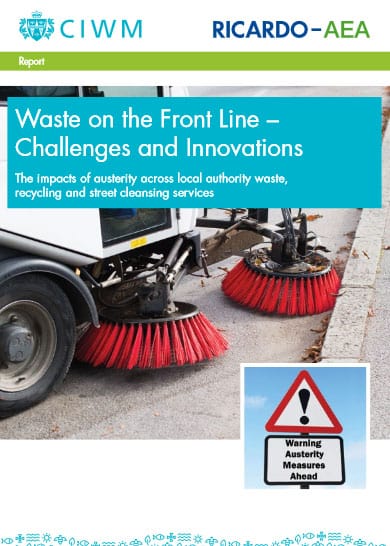
The report, ‘Waste on the Front Line – Challenges and Innovations’, is based on the views of 226 local authority waste officers at 183 authorities – 69% of whom have reported budget cuts due to austerity measures.
Almost half of those quizzed noted that there had been a reduction in their communications budgets, which can lead to ‘delayed impacts’, CIWM and Ricardo AEA noted, in the form of stagnating recycling rates.
Commenting on the findings, Mr Marshall said that communications schemes are a vital part of efforts to boost recycling rates and warned councils to think carefully about whether they could afford to cut communications budgets further.
Speaking at the launch of the report in Westminster yesterday (February 23), he said: “Communications budgets are being cut at a time when WRAP [the Waste and Resources Action Programme] tells us we have 25% of the population who ‘get’ recycling and at a time when reprocessors tell us material we are collecting is not of a good enough quality.
“The Recycle Now initiative from WRAP has been a great resource. But, evidence shows that people will lose interest if they don’t get consistent messages about it [recycling].
“For the local authorities in the room I would say that you need to think carefully about your communications when setting budgets. It may not be seen as part of the front line service but we all see the effect when it is not there.”
Austerity
The report also assesses the ‘hidden impact’ of austerity on council staffing, with 66% of respondents reporting that they had seen some form of departmental restructuring, 68% responding that vacant posts are not being filled and 61% subject to freezes in pay.
As well as evaluating the overall impact of austerity on council waste and recycling, the report also highlights a number of case studies of work that councils have done to improve the efficiency of their services.
Initiatives highlighted in the report include communications campaigns aimed at reducing recycling contamination, restructuring of contracts, reducing residual waste collection frequency, introducing charges for garden waste collections and use of technology to aid efficiency.
[testimonial id = “186” align=”right”]
Commenting, CIWM chief executive Steve Lee, said that initiatives like these are likely to become the norm for many councils over the next three to five years, with austerity measures expected to continue to bite until at least 2020.
“What we see here is some real innovation and willingness to explore the potential cost and performance benefits that can be achieved through smarter systems, joint working, and economies of scale. This report puts forward a valuable portfolio of ideas and measures for any council looking to make efficiency savings and will hopefully encourage the sharing of learning and best practice.”
He added: “We think most authorities will need to introduce initiatives like those in this report and that even smarter ways of working – in service delivery, partnerships and communications – will be needed. The challenges are here to stay and the innovation has to be maintained.”


Register for free to comment