

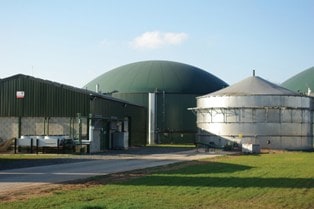
Anaerobic digestion has the potential to produce 11 TWh of energy by 2020 and make a significant contribution towards the UKs renewable energy goals, according to a new report.
But, this potential can only be realised if the coalition government pursues measures such as phasing out organic waste from landfill and promoting the source segregated collection of both municipal and commercial and industrial waste, the study from Liberal think-tank CentreForum claims.

The Hit the gas: How to get the anaerobic digestion sector moving report says that there are six priorities the government should pursue in total in order to fulfil its 2010 Coalition Agreement pledge to create a huge increase in the generation of energy from waste through anaerobic digestion.
These are:
- Phase out organic waste to landfill by 2020;
- Promote source segregated collection of Municipal Solid Waste (MSW) and Commercial and Industrial (C&I) Waste;
- Introduce accreditation of AD schemes at financial
close to fix all tariffs; - Encourage bio-methane injection to the grid;
- Encourage use of bio-methane to fuel Heavy Goods
Vehicles; - Ensure that the WRAP loan fund and Green Investment Bank have sufficient funds to support AD development.
Commenting on the report, Ed Davey, secretary of state for energy and climate change, said: “The government is committed to promoting an increase in energy from waste schemes through anaerobic digestion. CentreForum’s report offers some interesting ideas for how this increase can be achieved.”
Thomas Brooks, one of the reports authors, added: “There are some simple things government can do to release the brakes on anaerobic digestion. For instance, simply banning organic waste to landfill in England, as they are already planning to do in Scotland, would give anaerobic digestion a huge boost.”
Process
“This is an important report which lays out clear recommendations for how government can better support the anaerobic digestion sector”
Lord Redesdale, ADBA
The CentreForum study explains that anaerobic digestion (AD) is the process which breaks down organic compounds including waste to produce renewable energy and digestate, which can be used as a fertiliser.
It claims that the technology has several advantages over other forms of waste treatment and renewable energy generation including the fact that it produces biogas which can be used to generate electricity or heat or converted to biomethane which can be injected into the grid or used in transport fuel.
At present, AD produces about 1.3 TWh of energy in the UK enough to power 300,000 homes. But, the report claims there is the potential to increase this by over 800% to 11 TWh of energy by 2020.
However, it says that AD can only make a significant contribution to the UKs renewable energy commitments if the following barriers are removed:
- Gaining access to finance and feedstock;
- Lack of confidence in tariff levels remaining constant;
- A perception that government is opposed to further
expansion of AD from purpose grown crops (PGCs); - The high costs and stringent regulatory requirements
which must be met in order to connect to national
grids; - Absence of a mature market for digestate.
The report sets out the benefits of AD, describes each of the barriers and recommends actions to remove or reduce their impact.
Finance
On the subject of finance, the report notes that many AD schemes have struggled to secure financing. The small size of projects rules out non-recourse project finance, and the significant risks inherent in operating an AD plant generally mean that they have to be funded with a significant proportion of equity with any debt fully secured on assets, it claims.
The report says: ADs risks are more daunting at the pre-commissioning stage than once a plant is up and running successfully, so when sufficient AD plants are operating funding will become easier to obtain. In the meantime, the Waste and Resources Action Programme (WRAP) loan fund and the UK Green Investment Bank proposal to provide equity funding for AD will help to bring more schemes into operation.
The Anaerobic Digestion and Biogas Association (ADBA) should build on the experience of its Finance Forum to produce a succinct guide for developers and potential funders about ADs key financial risks and how they can be managed, as there still remain unrealistic expectations amongst some potential developers about financing AD schemes.
Feedstock
On feedstock supply the report notes that waste treatment AD plants often struggle to secure long-term supply contracts however the source segregation of waste feedstock can help.
It says: Only 13% of households in England have the benefit of separate food waste collection, whereas in Wales 82% are covered. The government should move to ban all food waste to landfill in England by 2020. There should also be financial support to local authorities to facilitate switching tosplit-body collection vehicles if the current fleet is not due to be changed for some time.
The report also claims there is a is lack of confidence in the stability of financial incentives
such as Feed in Tariffs and that the market for digestate is under-developed.
It says: Although the AD digestate market has a potential value of over 200 million a year, for most AD plants digestate is currently viewed as a cost. Defra and WRAP have recognised the need to help the market develop, and we welcome the initiatives they have taken. It would further help if regulations were amended so that farm co-operatives could spread waste co-digested with on-farm waste as long as both were pasteurised. More education about the benefits of digestate amongst farm end users and major supermarket buyers is also needed.
ADBA
Commenting on the report, Lord Redesdale, Liberal Democrat peer and chairman of the Anaerobic Digestion and Biogas Association (ADBA), said: “This is an important report which lays out clear recommendations for how government can better support the anaerobic digestion sector and realise the benefits it could bring to economic growth, waste management, renewable energy and climate change.
Related Links
“CentreForum have shown that anaerobic digestion already represents a significant part of the UK’s renewable energy mix – generating four times more electricity than solar PV – and are pushing for government to support an 800 per cent increase in that generating capacity by 2020.



Register for free to comment