

Viridor managers complete degree
Twenty managers working for Taunton-based waste management and recycling company Viridor have furthered their professional development by completing a degree.
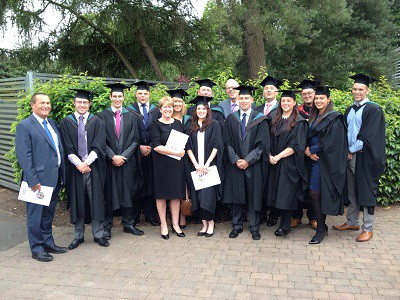
Starting in March 2013, the group of managers from across the business took part in a programme delivered by mentors in a classroom environment alongside remote learning whilst carrying out their regular jobs. The group received their Foundation Degree in Professional Development (Management and Leadership) after two years of hard work.
The Viridor Foundation Degree, accredited by Edge Hill University, was initially run in 2012 and is aimed at managers and supervisors who are seeking to personally develop their management and leadership knowledge base and skills.
According to Viridor, the fast pace of change in the resources and renewable energy industry has created a need for a ‘new breed’ of managers able to meet all of the requirements of modern day operations. Viridor is currently mid-way through a £2 billion investment programme in a network of energy recovery facilities along with recycling operations.
Working in partnership with Edge Hill University enabled Viridor to develop a curriculum that was tailored directly to the needs of its business, with modules focusing on managing change, employee engagement and leadership.
Chris Whittle, Viridor’s head of training and development, said: “I would like to congratulate all of our new graduates – it’s not easy combining this level of study with a demanding career, and I am proud of all of their achievements and of the positive impact this is having to our business. The modules cover subjects which are important to us as a business and the impact of the learning is spreading throughout the company and will continue to do so as more delegates join the course this year.”
______________________________________________________________________________________________
Government awards grant to APP consortium
A consortium of UK companies led by energy firm, Advanced Plasma Power (APP), has been awarded £11 million in government funding to develop and build the ‘first-ever plant of its kind’ to turn waste from homes and businesses into a fuel to power heavy goods vehicles.
The grant has been awarded to APP and its partners National Grid, clean energy firm Progressive Energy, and CNG Services, a company which provides gas for use in vehicles, as part of a Department for Transport (DfT) programme to develop and commercialise the technologies required to decarbonise the transport sector.
The new APP plant in Swindon will take residual waste and convert it into compressed biomethane, using APP’s Gasplasma technology and will produce enough fuel for 75 heavy goods vehicles. The technology sees residual waste shredded, dried, fed into a gasifier and then the resulting syngas being fed into a plasma converter to produce hot syngas and a by-product known as ‘plasmarok’. The syngas is then cleaned up for use as a biomethane fuel.
Biomethane can be used interchangeably with natural gas in heavy goods vehicles and, according to APP, has the potential to cut transport carbon emissions by up to 96%.
Construction of the plant will begin in 2016 and the consortium has already found local customers for the product and suppliers for the feedstock. The residual waste will be provided by a local source, and the gas produced will be used by local haulage company, Howard Tenens, and consortium partner CNG Services.
Rolf Stein, chief executive of Advanced Plasma Power, said: “APP is delighted to have been selected in this competition by the DfT. It recognises our position at the very forefront of environmental and technical innovation in the UK.”
______________________________________________________________________________________________
Hertfordshire AD achieves PAS 110
An anaerobic digestion plant in Hertfordshire operated by Biogen has become the latest to achieve the PAS 110 standard for the production of quality digestate.
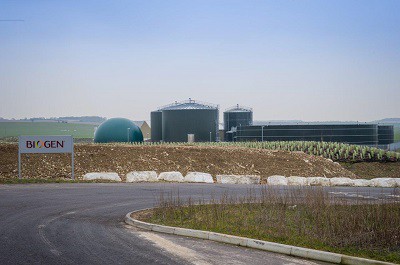
The Bygrave anaerobic digestion (AD) plant near Baldock processes food waste to generate renewable energy along with a nutrient-rich biofertiliser (also known as digestate) used on local farmland.
Around 45,000 tonnes of food waste from households, supermarkets such as Ocado and ASDA, food manufacturers and the hospitality industry is processed at the plant each year to generate 2.6 MW of green electricity.
The PAS 110 accreditation given to AD operators by the Biofertiliser Certification Scheme (BCS) provides assurance to consumers, farmers, food producers and retailers that the biofertiliser produced from anaerobic digestion is safe for human, animal and plant health and is fit for spreading to farmland as a replacement for chemical fertilisers.
According to Biogen, only 37 AD plants in the UK have achieved the certification to date and it is the only operator to have five accredited plants.
Julian O Neill, Biogen chief executive, said: “I’m extremely proud that our AD plants have the PAS 110 certification. Our unstinting focus on operations excellence and compliance across the organisation, coupled with industry leading plant design is reflected in the achievement of this most recent award.”
Biogen, which employs 100 people, has five other operational AD plants in Bedfordshire, Northamptonshire, Denbighshire, Caernarfon and Rhondda Cynon Taf. A further plant in Warwickshire is in its commissioning phase and due for completion this year.
_____________________________________________________________________________________________
Changes made to Packaging Regulations
Changes to the Packaging (Essential Requirements) Regulations are due to come into force on 1 October 2015 after being laid before Parliament earlier this month (September 4).
The Regulations implement the requirements of the EU Directive on Packaging and Packaging Waste and set the essential requirements packaging must meet before it can be placed on the market – preventing, among other things, excess packaging. They are distinct from the Producer Responsibility Obligations (Packaging Waste) Regulations which require packaging producers to pay towards the cost of recycling waste packaging.
The new 2015 Regulations replace those from 2003 and effectively consolidate the existing requirements following the government’s bid to reduce red tape under the Red Tape Challenge. In other respects the regulations remain the same.
The explanatory memorandum accompanying the revised Regulations explains: “No formal consultation has taken place as this is a consolidation exercise and no changes to the obligations or requirements of economic operators are being made.”
The revised Regulations can be found here.

Register for free to comment