

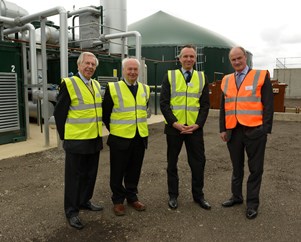
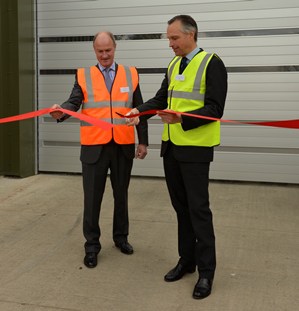
Environment minister Lord de Mauley said he was delighted with the expansion of anaerobic digestion in the UK as he officially opened Agriverts 10 million AD facility in Wallingford, Oxfordshire on Friday (May 17).
The Wallingford plant constructed and operated by organics recycler Agrivert is the last of six organic waste facilities built by the firm under a 20-year contract to provide food waste treatment for Oxfordshire county council. Oxfordshires food waste is also treated at Agriverts Cassington AD plant in nearby Witney and four of the firms composting sites.
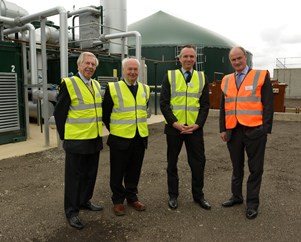
With a capacity of 45,000 tonnes per year, the facility also treats municipal food waste, as well as other types of solid and liquid organic wastes, under a 25-year contract with the Royal Borough of Windsor and Maidenhead (see letsrecycle.com story).
The AD process at Wallingford produces 2.3MW of electricity enough to power 4,000 households and a PAS 110-certified digestate fertiliser for spreading on more than 2,500 acres of local farmland.
The plant, which took eight months to construct, began taking in a small amount of waste in January 2013, but is now operating at three-quarters of its capacity and estimated to be working at full capacity within the next few months.
Speaking at the opening, Lord de Mauley said: We have seen the benefits of AD today from this sort of facility. It diverts waste from landfill, produces energy and creates a digestate for use on farmland and the Wallingford facility can process a wide range of organic waste. There is support for AD in a number of ways from the government, such as a 10 million loan fund, Renewable Heat Incentives and we have produced a strategy and action plan to increase energy from waste through AD. We are delighted that the sector is expanding.
‘There is support for AD in a number of ways from the government, such as a 10 million loan fund, Renewable Heat Incentives and we have produced a strategy and action plan to increase energy from waste through AD. We are delighted that the sector is expanding.’
Lord de Mauley, environment minister
He continued: Turning what was once automatically sent to landfill into renewable energy not only makes environment sense it makes business sense too. The waste and recycling sector represents a huge opportunity for UK businesses and will help grow our economy; the Wallingford AD plant is an excellent example of this.
Also speaking at the opening of the Wallingford plant, Alexander Maddan, chief executive of Agrivert, said there had been a tremendous amount of work into getting the facility built.
He said: We have been trying to build this plant over the last 18 months there has been a tremendous amount of work to get this running. It removes the gas and turns it into energy and we produce a very sustainable fertiliser. In the UK we have to work more to turn things into renewable energy.
He added: But what does this do for the community? We have seven employees full-time and will also have 24 further staff at various times throughout the year from the community. We look forward to 25 years with our contractors and with farmers, which we have worked hard to build up. These are 25-year relationships and are very important to us.
Methane
He said: The production of energy is in many ways the smallest environmental benefit of this plant. The biggest environmental benefit of processing food waste is actually capturing methane, which is a powerful greenhouse gas that we turn into energy.
Around 14% of greenhouse gases in the UK are produced from farming and agriculture, and around half of this is thought to come from non-organic fertilisers.
However, Mr Waters said more government support and subsidies were needed to enable methane produced through AD in the UK to be sent straight to the gas grid. Currently, methane gas produced at Wallingford is fed into an onsite gas engine to produce electricity for the national grid.
He said: Of the power we get through the current process we lose around 60% in heat. So it is not a very efficient way of doing things. The most environmentally sustainable way is by putting it straight back into the gas main.
We would like to put the methane back into the gas chain, but the subsidies are just not there and gas utility companies have no obligation to take our gas. The clean-up cost for methane gas in the UK to enable it to be placed back into the grid is around 1.5 million, which is a real barrier to entry at the moment. The cost of fitting machinery to put methane gas back into the grid is also very expensive.


Register for free to comment