

However, the authority explained that actual tonnages of recycling have risen, but overall residual waste has also grown by a larger amount.
Statistics in the report showed that the overall household recycling performance dropped for the fourth consecutive year in 2019/20 to 37.2%, down from 37.8% in 2018/19.
This rate falls short of the 50% recycling target the MRWA set for 2020 in its Joint Recycling and Waste Management Strategy, published in 2011.
The MRWA is responsible for the disposal of municipal waste on Merseyside. It is a statutory Authority that works with all councils on Merseyside – Knowsley, Liverpool, Sefton, St Helens and Wirral.
The authority works in partnership with its waste contractor, Veolia.
District councils
Specific recycling performances achieved for each district council within the MRWA is also outlined in the report.
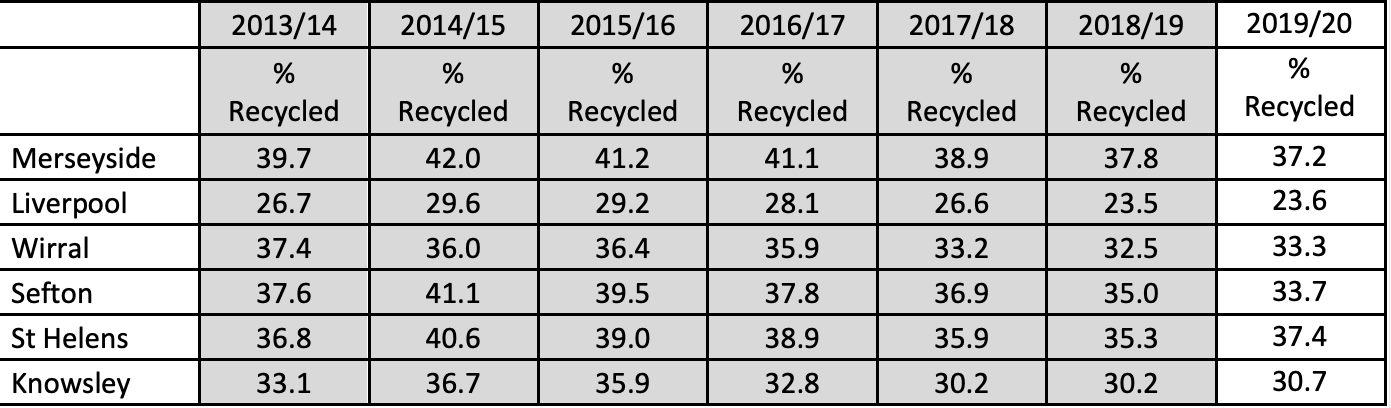
The city of Liverpool reported a 23.6% rate, which was slightly higher than the rate for 2018/19 which stood at 23.5%.
Wirral reported a 33.3% rate compared with a 32.5% rate last year, while Sefton’s rate dropped from 35.0% to 33.7%.
St Helens saw the biggest leap, jumping from a 35.3% rate in 2018/19 to 37.4% this year.
Knowsley saw a small increase, reporting a 30.7% rate in 2019.20 compared with last year, which was 30.2%.
‘No simple answers’
Carl Beer, chief executive of the MRWA, explained to letsrecycle.com that there are many reasons as to why the lower rate has been recorded, and pointed to the greater residual tonnages.
“It’s obviously disappointing whenever the recycling rate falls as we all want to recycle and reuse as much material as we possibly can,” he said.

Mr Beer added: “The Liverpool city region actually recycled more material than the previous year – 276,436 tonnes of household waste recycled in 2019 compared to 272,942 tonnes of household waste recycled in 2018. However, household residual (non-recycled) waste has risen at a greater rate than recycling tonnages, which is one reason why the recycling percentage has decreased.
“Our Household Waste Recycling Centres continue to perform well and since 2015/16 their recycling performance has been going up year on year.”
Households
Mr Beer went on to explain that the region is a “diverse place with many different household types which can make collections problematic”, and added that the issue with increases in residual waste is not unique to them.
“ Like most local authorities financial limitations remain challenging. We continue to work with our partners across the region to embed Circular Economy thinking into strategic policies and plans and improve waste and resources management in a time of climate emergencies, the Covid-19 pandemic and rapid global and environmental change.
“Once we’ve got through the significant challenges presented by the pandemic, we’re looking to the future and opportunities presented by the Waste & Resources Strategy, working with district council partners, our waste contractors and local community groups, and taking recycling and reuse performance to the next level.”
Waste development Fund
The recycling rates are outlined in a wider report assessing the distribution of the £28.9M Waste Development Fund, which was distributed to each district council making up the Merseyside Waste Authority in 2014.
The annual update is comprised of assurance from the district councils as to how they have spent the money from the fund that was allocated to them.
The Waste Development Fund was set up to contribute towards the delivery of the Joint Recycling and Waste Management Strategy.

Register for free to comment