


Members of the London Assembly Environment Committee have criticised Mayor Boris Johnson for failing to take a strong lead on recycling, and have questioned why recycling rates in some of the capitals boroughs have declined.
The comments came at a Committee meeting at City Hall this morning (November 27), where the Mayors senior advisor for environment and energy, Matthew Pencharz, and London Waste and Recycling Board (LWARB) chief executive Wayne Hubbard were questioned over progress towards the targets set out in the Mayors Municipal Waste Strategy.

Key among the targets are aims to send zero waste to landfill by 2025 and recycle or compost at least 60% of Londons waste by 2025 (see letsrecycle.com story).
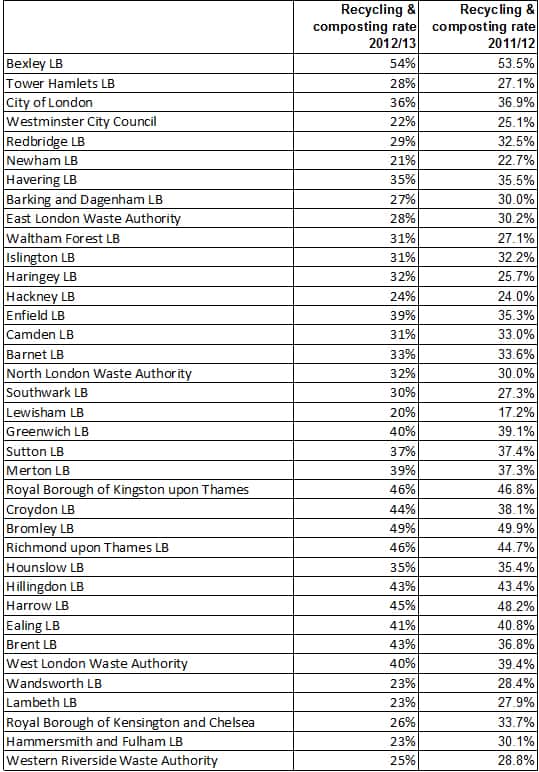
Green Party assembly member Jenny Jones enquired why local authority recycling data published this month (see letsrecycle.com story) for the 2012/13 period showed that 16 out of the capitals 32 boroughs had seen a decline in the amount of waste recycled when compared to the previous year.
Ms Jones also questioned the political will of the Mayor with regard to improving recycling rates.
Progress
The recycling rate for the whole of London remains relatively low when compared to the rest of England, rising by around 0.1% to 34% in 2012/13 compared to 43.2% across the country. Assembly members also pointed out that London faired relatively badly when compared to other large UK cities including Manchester and Leeds which recorded recycling rates of 42% and 36% respectively.
London Conference
For an in depth look at issues surrounding recycling in the city, sign up for the London Conference organised by letsrecycle.com in February 2014. Click here for details.
In response, Mr Pencharz noted that plateauing recycling rates were not exclusive to London, but said that the trend continues to be concerning for the Greater London Assembly.
He said: We are all concerned by the levelling off of recycling rates. But, it is the same around the country, not just in London. We do not live on an island. We have a high population churn, and a lot of people for whom English is not their first language, so communications is a challenge. We are working with the LWARB to try and change that.
Mr Pencharz also suggested that ultimate responsibility for increasing recycling rested with the London councils rather than the Mayors office, adding that the questions should be posed to the London boroughs themselves, who are obligated to collect and recycle the waste.
Communications

Ian Davis, director of environment for the London borough of Enfield, who was among the other experts questioned by the Committee, confirmed that communications continued to be a challenge for London councils, especially for those with a large proportion of privately rented accommodation.
He added: Communications is one of the areas we need to put a lot of work into. Where we are finding problems with contamination in recycling collections that is a communications issue. We also have a large number of private landlords which results in a big turnover.
What we have noticed in more stable areas and places where English is the first language is that there are much higher levels of recycling.
District heating
The Committee also examined the capacity of energy from waste (EfW) infrastructure available to treat waste generated in the capital, while the soon to be launched district heating scheme using heat from the South East London Combined Heat and Power Plant (SELCHP) was welcomed (see letsrecycle.com story).
Related Links
It was also revealed that a similar scheme may be established for the north of the city, with North Londons councils exploring the possibility of using heat from the Edmonton incinerator, under plans being drawn up following the scrapping of the North London Waste Authority contract procurements (see letsrecycle.com).
London’s recycling rates compared: 2012/13 & 2011/12
*Figures derived from data provided by the Department for Environment, Food & Rural Affairs


Register for free to comment