

It follows a front page Daily Mail article published this morning amid the ongoing political wrangling over weekly bin collections, claiming that only 17 of 285 local authorities in England collect all waste and recycling bins on a weekly basis, covering 4.3 million people.
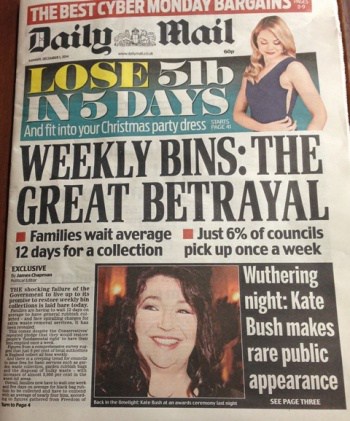
The newspaper said the information – based on freedom of information requests to ‘every council in the country’ – showed that on average general waste bins are collected from households every 12 days, recycling bins are collected every 13 days and food waste is picked up every nine days. Meanwhile garden waste collections take place on average every 12 days.
Entitled ‘The great betrayal over weekly bins’ – the article also lists the councils in England it claims are bringing in the highest revenues from levying extra charges to residents for services such as garden and bulky waste collections.
It claims that Purbeck council in Dorset levies the most charges for extra collection services in England at an average of £43.49 per household, which brought in revenues of £869,797 in 2013/14. This is allegedly followed by Adur council in West Sussex and Rushcliffe in Nottinghamshire.
However, Dorset Waste Partnership’s head of strategy Bill Davidson told letsrecycle.com the £869,797 figure attributed to Purbeck in fact refers to the revenues of all seven councils in the DWP.
Elsewhere in the article, Communities Secretary Eric Pickles is also labelled the ‘minister for hot air’ by the newspaper for his ‘crushing failure’ to enforce weekly collections through the likes of his £250 million weekly collection fund.
LARAC
However, reacting today (December 1) chair of the Local Authority Recycling Advisory Committee (LARAC) Andrew Bird argued that the article neglected to take into account “severe” council budget cuts and the fact that many authorities do in fact currently offer some sort of waste or recycling collection every week.
Speaking to letsrecycle.com, Mr Bird said: “Many people do have weekly collections, it is just that one week it is normally recycling and the other it is residual. And generally that works very well for councils.”
And, commenting on council charges for specific collection services, he said: “Garden waste is a non-statutory service, so councils can make a charge for that and because of the severe cuts in funding it has become a necessity.”
He also explained that although bulky waste collections are a statutory service, councils are allowed to apply for an exemption for this which enables them to charge residents.
[testimonial id = “109” align=”right”]
Mr Bird said: “Because of the severe financial climate we are in, that is why more and more authorities are having to charge for certain services.”
However, he said that on average, it costs council tax payers in England 50p per week each to carry out general waste and recycling collections.
“As waste and recycling collections are such a visible council service, many people may not realise that the majority of council tax goes towards health, education and highways.”
DCLG minister Mr Pickles told the Daily Mail earlier this year he was considering amending the Household Waste Recycling Act 2003 to make it more difficult for councils to operate fortnightly collections (see letsrecycle.com story), but has come under fire from within the waste sector for his strong stance on the issue (see letsrecycle.com story).
Related Links:
– LARAC


Register for free to comment