

With new standards and digital obligations on the horizon in 2026, manufacturers supplying the waste sector are entering a period of transition.
The waste industry has moved from a period defined by mechanical reliability and compliance-led design, through rising pressure on safety, uptime and cost control, and is now entering a phase shaped increasingly by digital requirements, data and transparency.
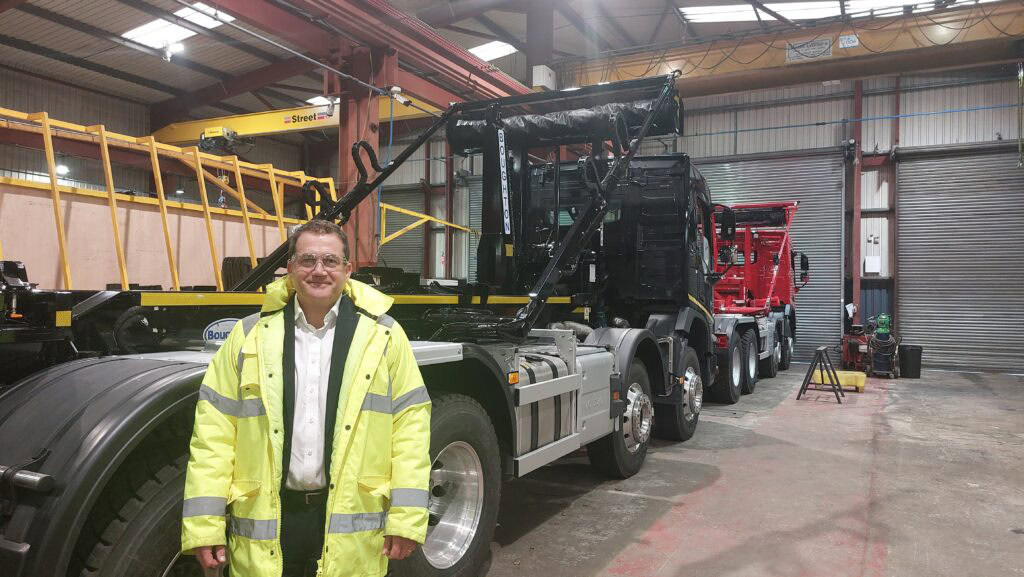
Dating back to the late 19th century and with a long-standing focus on waste equipment, Boughton Engineering has evolved alongside the sector.
Founded in 1897, the business has operated across agriculture, forestry, transport and military applications, following shifts in national demand rather than chasing trends.
Its move into waste equipment in scale began in the 1970’s, when it first started producing hook loaders followed by skip loaders and ejector trailers. In 2008 Reynolds Boughton acquired the assets of Trio skip loaders and hook loaders which included the Maclift and Telehoist brands.
Today, Boughton, which was acquired by Skan Group Holdings in 2011, is the only UK manufacturer of hook loaders and the largest volume manufacturer of skip loaders, supplying equipment to a sector that increasingly demands reliability and transparency.
From industrial backbone to skills shortage
Government support for UK manufacturing has been “thin” in the 21st century.
Richard Skan, who is also Group Managing Director of Skan Group Holdings Ltd, explained: “Through my first decade with the Skan business, UK manufacturing contribution to GDP reduced by half. Governments at the time were putting onus on the service sector and public sector.
“Quite a lot of damage had been done and a lot of skills had then gone out of our industries, so trying to find skilled fabricators, fitters and electricians has been very hard.”
However, Skan explained that there are still many advantages of manufacturing in the UK. Producing equipment domestically gives Boughton greater oversight and control of its supply chain, manufacturing quality and delivery schedules, reducing exposure to shipping disruption, exchange rate volatility and overseas capacity constraints.
When asked what policy support he would like to see, Skan added: “The absolute key thing in our business is people and skills.
“The government needs to consider how developing the apprenticeship framework could help deliver the engineering and technical skills we so badly require while also ensuring there is adequate support for R&D that will drive our ability to innovate for the future.”
What operators need now
Despite political and technological change, meeting customer needs has remained the principle behind innovation in the waste sector.
Safety marks a clear driver. Once largely a matter of compliance, it has become a core design catalyst shaped by both regulation and real-world experience. Camera systems, enhanced visibility and recording technology are now embedded into waste vehicles as standard or optional features.
For operators, durability is no longer a competitive advantage but a baseline expectation. Boughton has focused on reinforcing this through incremental engineering improvements, using CAD design and finite element analysis to optimise strength, reduce stress points and extend service life without adding unnecessary weight or complexity.
In some cases, customer incidents have directly prompted further innovation. Following an issue during a routine maintenance procedure, one operator asked Boughton to develop a secondary fail-safe that would prevent injury even if an error occurred.
Rather than treating this as a bespoke fix, Boughton engineered a “belt and braces” safety solution that was subsequently made available to all its customers.
The industry has increasingly recognised that downtime, not capital cost, defines value. With fuel, labour and compliance costs continuing to rise, every hour off the road matters.
In response, Boughton has expanded its focus beyond product design to operational support, investing in parts availability and service responsiveness to enable next-day delivery of spares and the target of next-day provision of service engineers or third-party providers
Looking into 2026
If the last decade of waste sector manufacturing has been defined by durability and safety, the years leading to 2026 look set to be shaped by digitalisation. Once an optional extra, digital tools are rapidly becoming operational necessities, driven by regulation, efficiency pressures and rising expectations around transparency and compliance.
Digital product passports will require manufacturers to provide accessible information on the origin, maintenance and end-of-life sustainability of equipment, while the upcoming ISO 9001:2026 standard places greater emphasis on digital systems across quality management and customer interaction.
For Boughton, this shift extends beyond manufacturing into aftercare and operations. The development of its sister company Skantag now sees every Boughton vehicle fitted with a bespoke QR code linked to an online portal holding manuals, service history, compliance documentation and spare parts, with 24/7 self-service online ordering available.
For operators, the development of Skantag replaces manual record-keeping with real-time data, supporting improved asset management for both vehicles and containers. As scrutiny around duty of care and waste crime increases, digital tracking also provides a clear way to demonstrate where assets have – and have not – been.

Register for free to comment