


The injury rate (injuries per 100,000 employees) for the sector is still “much higher” than in the agriculture and construction sectors, but HSE said the overall trend is downward for injury numbers in waste and recycling over the last few years.
![HSE table showing number and rate (RIDDOR) of major/specified injury to employees in waste and recycling [please click on image to enlarge]](https://www.letsrecycle.com/wp-content/uploads/2021/07/major-injuries-HSE.jpg)
However, it added that due to several changes in RIDDOR (Reporting of Injuries, Diseases and Dangerous Occurrences Regulations) reporting in recent years, analysis of trends or comparisons with previous years’ figures – as well as “uncertainty in the employment estimation” – needs to be “treated with caution”.
The injury figures released today follow fatality data released by the HSE in July 2014, which showed that there were four waste and recycling worker deaths in 2013/14 – lower than the 10 worker deaths recorded the previous year (see letsrecycle.com story).
Rick Brunt, who took over as HSE’s head of the waste and recycling sector earlier this year (see letsrecycle.com story), described the decrease in injuries in the waste and recycling industry as a “further step in the right direction, continuing the decline seen last year”.
He added: “Nonetheless I would urge the industry to avoid complacency and recognise there is still a long way to go. As a priority sector for HSE we will continue to work with the industry to address the poor safety record to further reduce the toll of death and injury.
“Everyone involved in the industry has a responsibility to focus their efforts on reducing the number of incidents, and making sure that people working in the industry go home safely at the end of the day, and the shocking number of unnecessary deaths and injuries is tackled.”
According to HSE, which in January 2015 marks 40 years since its creation, across all sectors the cost to society from such injuries and new cases of ill health due to current working conditions is estimated at £14.2 billion based on 2012/13 figures and prices.
[testimonial id = “68” align=”right”]
Over-seven-day injuries
Elsewhere in the statistics document published today, HSE states that over the last decade “there has been little change in the number of reported injuries to waste and recycling employees” for over-three-day and over-seven-day incapacitation, despite a broad decline in injury rates over recent years.
And, it adds that the reduction in injuries in this area over the last two years was “expected” following the change from the over-three-day to over-seven-day reporting from 2012/13.
In April 2012, the RIDDOR threshold for non-fatal injuries to workers switched from over-three-days’ incapacitation to over-seven-days’, which affects statistics from 2012/13 onwards.
Therefore, comparisons with injury statistics from previous years should be “treated with caution”, HSE says, although there were 1,563 reported over-seven-day injuries in 2013/14 compared with 1,725 the previous year.
Ill health
According to the statistics, the Labour Force Survey (LFS) can only provide data about waste and recycling by grouping data from several years, as the number of waste and recycling cases captured by the survey is relatively small.
Nonetheless, between 2008/09 and 2013/14, statistics show that around 6,000 workers in waste and recycling suffer from a self-reported illness caused or made worse by their current or most recent job – although there are around half as many new cases each year.
In the sector currently, around 219,000 working days are lost each year due to this ill health in the sector, which is the equivalent to 1.7 days for each worker in the industry, or 35 days for each worker who is affected.
Enforcement
HSE and local authorities are responsible for enforcing health and safety legislation, and the statistics released today show that the number of offences and cases heard in 2013/14 were below the average of the last five years, but that fines issued were above the average.
In 2013/14 there were 25 waste and recycling prosecution cases covering 41 charges, of which 24 cases and 39 charges resulted in guilty verdicts.
The average fine per offence was around £36,600, while the average per case was around £59,500. Four cases accounted for three quarters (74%) of the total fines.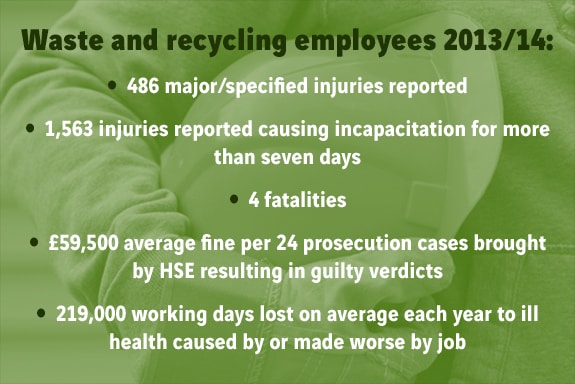
Fatalities
In July it was revealed that there were four worker fatalities in the sector in 2013/14 – two to self-employed people – while one member of the public died during this period. These figures were lower than in the preceding year, when there were 10 worker deaths in the sector and two fatalities to members of the public (see letsrecycle.com story).
According to HSE, over the last five years (2009/10 to 2013/14) 29% of fatalities in the sector were due to workers being struck by vehicles and 17% involved contact with machinery.
Furthermore, just over half (12) of the 22 fatalities to members of the public in the most recent 10 years involved moving vehicles, while one in seven (3) involved contact with machinery.
| 2008/09 | 2009/10 | 2010/11 | 2011/12 | 2012/13 | 2013/14 (p) |
|
| Waste and recycling industry worker fatalities | 10 | 3 | 9 | 5 | 10 | 4 |
| Fatal injuries to members of the public | 2 | 3 | 2 | 1 | 4 | 1 |
| Total | 12 | 6 | 11 | 6 | 14 | 5 |

Register for free to comment