



Russell Davies, CEO of Exchange for Change, said: “The publication of our material specification is a milestone in providing producers with the clarity they need to prepare for the Deposit Return Scheme. It sets out in practical terms how packaging should be labelled so it can work effectively within the system from day one.
“Our focus is on making sure businesses have the time, certainty and support they need. By publishing this guidance now, we’re helping producers plan ahead, align packaging changes with their existing cycles and avoid unnecessary disruption as we move towards launch.
“This is part of our wider work to support industry readiness for the deposit return scheme’s launch in October next year. We will continue to provide further detail, guidance and engagement opportunities as the scheme develops.”
The guidelines set out:
- In-Scope container materials
- The size ranges covered
- Labelling & Barcode requirements
- Product Registration & Testing
It confirms that that the scheme will apply to bottles and cans for water and beverages (both soft and alcoholic drinks) for human consumption, with capacity of at least 150 millilitres but no more than three litres of liquid.
Containers are in scope if made “wholly or mainly” of PET, Aluminium or Steel.
The container dimensions are to be:
| Dimension | Minimum | Maximum |
| Outer Width | 50mm | 125mm |
| Height (with cap on) | 75mm | 360mm |
Containers must also be able to lie flat in order to be accepted by the Reverse Vending Machines (RVMs).
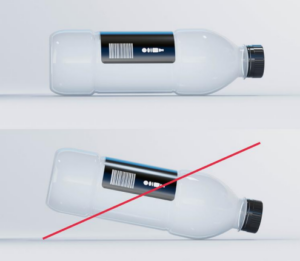
Non-cylindrical containers (square in shape) or top-heavy containers risk jamming RVM equipment and will require additional testing.
Exchange for Change said that it may contact producers regarding drinks containers that require further testing.
The guidelines set out compaction requirements for both material types, which must be able to be compacted by:
- PET bottles: Minimum of 55% during compaction
- Aluminium/Steel cans: Minimum of 75% during compaction
All producers must register their existing products with Exchange for Change no later than 12 weeks prior to the go-live day of 1 October 2027, making the deadline for this 9 July 2027.
The specification also identifies low-volume product exemption, which is designed to reduce the impact on small producers.
Logistics tender opens
This week, a closed process for the appointment of the regional logistics and processing contracts for the DRS moved into the tendering stage.
The process, led by Exchange for Change, will appoint providers capable of managing the movement and treatment of returned drinks containers across England, Scotland and Northern Ireland.
A spokesperson for Exchange for Change commented: “Extensive market engagement has been undertaken to inform this investigatory analysis and provide a clear view of current market conditions across processing, logistics, and collections.
“Initial engagement began in 2025 focusing solely on logistics and was expanded in February to encompass all three market segments (collection, counting, and sorting).
“Potential partners have welcomed the integrated solution model, and there is confidence in the timelines required to establish or repurpose processing facilities ahead of the 2027 launch.
“Overall, the response from the market has been both constructive and encouraging.”
Deposit Return Scheme
The UK’s DRS is scheduled to launch in October 2027.
Under the regulations, all participants in the drinks supply chain – including producers, importers, wholesalers and retailers – will be required to apply the deposit when selling in-scope drinks. Containers must also carry specific scheme labelling.
Items included in the DRS will be excluded from extended producer responsibility for packaging (pEPR), avoiding overlapping obligations for producers.
Exchange for Change
Exchange for Change is the not-for-profit Deposit Management Organisation (DMO) established to design and deliver the DRS across England, Scotland and Northern Ireland.
The body is responsible for overseeing the scheme’s operation, including setting the deposit level, achieving collection targets and issuing guidance to both businesses and consumers as implementation progresses.
Recently the organisation has also outlined an exemptions framework for reverse vending machine (RVM) requirements.
Under this approach, retailers in urban areas with a retail space of less than 100 square metres will be automatically exempt from hosting a return point.
Find out more about the policy and regulation updates, technology and infrastructure, and consumer engaging ahead of the introduction of the scheme at the Deposit Return Scheme Conference on 30 April 2026 in London.

Register for free to comment