

The forecast adds together both the expected volume of EfW intake available in the UK as well as in facilities available on the Continent. And, the 2020/21 prediction means that the consultancy has again put back its estimate of when overcapacity might be reached for EfW.
The latest estimate comes in the ninth edition of the consultancy firm’s Residual Waste Infrastructure Review, published at the end of December 2015.
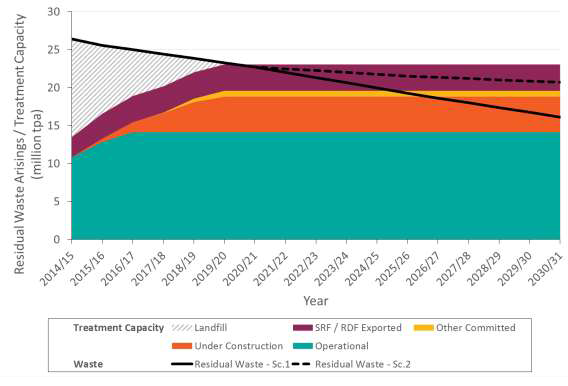
The review, which is updated twice a year, now forecasts that the overall availability of EfW facilities for municipal, commercial and industrial waste will total 23.1 million tonnes per year in 2020/21.
If all of this infrastructure is utilised, Eunomia claims, this capacity will outstrip the available 22.7 million tonnes of residual waste expected to be produced that year (see chart below).
Looking further ahead, Eunomia predicts that the level of excess demand could rise to 6.9 million tonnes in 2030/31, including RDF export. It adds that these levels may even be reached earlier if capacity which has not yet reached financial close is built out.
The forecast puts Eunomia once again at odds with the waste industry’s claim that the UK could experience a waste capacity treatment gap within the next decade.
Data
The Eunomia reports draw on data from WasteDataFlow returns, Defra C&I data and its own in-house Facilities Database, which holds information on residual treatment facilities both operating and under development.
This latest forecast by Eunomia moves the overcapacity date by several years. In June 2015 it suggested that the UK was then just four years away from a surplus in EfW capacity while in 2014 it predicted that capacity could be exceeded by 2017/18. In its June 2015 review, Eunomia had published its expectations that EfW capacity supply would hit 23.9 million tonnes per year by 2019/20.
And, in its seventh review published in November 2014 – the consultancy reported treatment capacity would exceed available throughput by 2017/18. Prior to that, Eunomia had claimed this situation was only likely by 2018/19.
Explaining the latest amendment in its ninth edition of the review, Eunomia states that for the first time it has not included EfW facilities with planning consent which are yet to reach financial close in its modelling – including only plants that are operational, under construction, or have secured funding.
In addition the consultancy had revised downwards its capacity estimates for a number of facilities to reflect recent data and expectations regarding their performance.
Despite these concessions, Eunomia states that its main findings ‘continue to refute those of other commentators’ and argues the supply of treatment capacity due to exceed the amount of waste available.
It adds that since its last review, the need to achieve the 65% recycling target adopted in the European Commission’s revised Circular Economy Package means the UK could be forced to minimise the amount of residual waste it produces by 2030. While the target has yet to be formally agreed at EU level, European politicians will debate the proposed target levels in the coming year.
Eunomia also suggests the UK will exceed available feedstock in a ‘low recycling’ scenario – in which the UK does not reach 65% recycling by 2030, and both commercial and industrial waste recycling continue at expected 2020 levels.
Disparity
Commenting on the reasons for the disparity with other waste capacity reports, Adam Baddeley, lead author of Eunomia’s Infrastructure Review, said: “When you focus on the overall conclusions of the reports, they appear consistent with one another, and Eunomia looks like the odd one out. However, breaking them down and looking separately at their estimates of capacity and arisings produces a rather different picture.”
He added: “The interesting question isn’t – ‘Why are Eunomia’s conclusions different?’ Rather, it’s ‘Why, despite disagreeing so significantly on their assumptions, do all of the other reports reach the same conclusions?’”
Eunomia went on to suggest that in ‘broad terms’ its estimates for waste arisings are similar to those of Biffa, the Green Investment Bank and Tolvik – while its estimates for capacity also broadly align with those of Ricardo-AEA and Suez.

Register for free to comment