

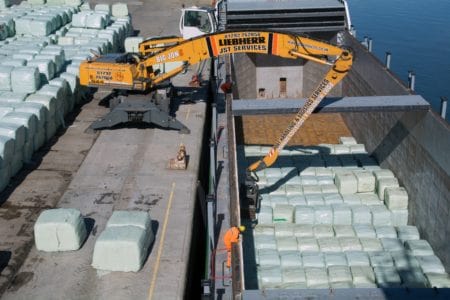
This is one of the findings of a report “RDF Export – analysis of the legal, economic and environmental rationales”, published today by Bristol-based consultant Eunomia for a group of RDF exporters and incinerator operators.
Mike Brown, managing director of Eunomia, secretariat to the RDF Export Industry Group, said: “This evidence-based report should help to progress the debate on RDF exports away from some of the misconceptions about it being key to waste being abandoned in the UK, or that this is where we should focus (rather than at source) in order to move waste up the hierarchy, or even that it causes the loss of a significant amount of fuel that otherwise would be available domestically.”
Transport
On transport, the research found that overall while the emissions from transport are four times greater in export scenarios compared to UK scenarios, emissions from transport account for just 3% of total emissions. In particular, the study notes that “RDF is often ‘back-hauled’ which can effectively eradicate transport emissions”.
The transport impacts are assessed against an overall background of net carbon dioxide equivalent emissions for five scenarios for using the waste, ranging from (scenario 1) Export electricity only, through to using CHP in the export markets and, similarly, electricity only or CHP at home with the final scenario 5 being landfill in the UK.
| NET CLIMATE CHANGE IMPACTS | kg CO2e |
| Scenario 1: Export electricity only | 1,774,093 |
| Scenario 2: Export CHP | -89,883 |
| Scenario 3: UK electricity only | 1,512,555 |
| Scenario 4: UK CHP | -351,421 |
| Scenario 5: Landfill | 2,462,216 |
The document reasons that emissions avoided through energy generation (‘energy output’) are far higher under the CHP scenarios than under the electricity only scenarios.
Hierarchy
Eunomia emphasise the need to follow the waste hierarchy with the removal of recyclables which impacts on the benefits of sending RDF to the Continent.
On regulation, the study notes that within existing legislation, there is only a limited legal basis for any kind of treatment ‘standard’ to be introduced for exported RDF and this would be challenging and costly (both to Government and industry) to enforce. The basis for this standard would have to relate to the application of the waste hierarchy, which would need to apply equally to residual waste treated domestically.
And, in terms of getting RDF exporters to try and take out recyclables from the residual waste stream, Eunomia suggests that it is more effecting for Defra and the EA to focus on capturing recyclables and food waste at source from municipal and commercial wastes.
Standard
In conclusion, the evidence presented in this study, states the authors, strongly suggests that the legal framework does not provide for any sensible means of Government intervening to set a restrictive standard for exported RDF. “Furthermore, the environmental and economic impacts of RDF export are not wholly dissimilar from domestic treatment of residual waste.”
In terms of markets for RDF on the Continent, Eunomia point to data showing exports continuing and find that the Environment Agency is mistaken in suggesting that RDF exports may be levelling off due to export routes becoming as expensive as English landfill.

UK operators
The report also contains a warning for operators of incineration plants in the UK that their gate fees may fall as recycling increases. The study states: “The rate of increase in levels of recycling has declined over recent years and some local authorities have recently reported rises in residual arisings.”
It continues: “At the same time, however, the UK has a target to recycle 50% of waste by 2020 and if recycling continues to increase, and therefore residual arisings decrease, in line with legislative drivers, there will be a resulting fall in residual waste requiring treatment. This is likely to lead to more competition for this waste, and thus may lower the cost of UK incinerator gate fees.”
Source: The full report can be downloaded here: RDF Export.


Register for free to comment