


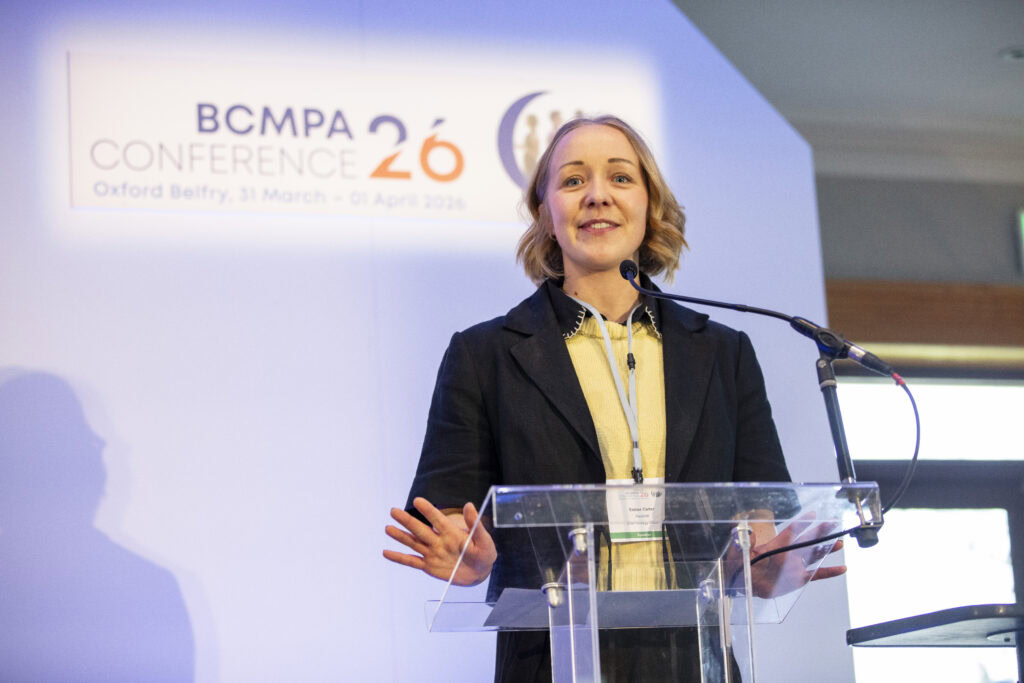
How did you come across what is now your role at PackUK?
I remember reading the job description – several people had sent it to me – and thinking it perfectly aligned with my passions, strengths and experience!
My career has always been in the consumer and retail spaces, and more recently recycling and waste. The common tenants throughout all of it has been system thinking across complicated value chains, engaging with different stakeholder groups, and using data and analytics to underpin decision making.
And, at its heart, that is what the Chief Strategy Officer role is about for me: combining long-term strategy with short-term delivery. It’s not just thinking about what the world looks like in 50 years’ time or just focusing on what next week needs to look like – it’s being able to do both those things at the same time. That’s the stuff that I really enjoy.
Before PackUK, you worked at Delterra. How did that experience prime you for taking on your current role?
Delterra is an environmental non-profit focused on circularity and recycling systems, mainly in the Global South. It was founded by McKinsey and Company, where I previously worked.
I joined to help build the organisation and ended up moving to Indonesia, where we were setting up waste systems in places where they either didn’t exist or they were incredibly nascent.
And I think that was what got me really interested in how you make the economics and the whole value chain work.
What did you learn from working internationally?
A lot of the fundamentals of waste management are the same everywhere – can you collect the thing? Can you separate the thing? And is there a way to process it and sell it into an end market at cost?
The challenge is making that work economically and driving behaviour change, both at a citizen level and a producer level.
I also worked in Argentina and Brazil. Different countries have different starting points, but the core system challenges are surprisingly similar.
Is the UK a particularly complex environment for the introduction of an EPR system?
It’s a complex environment for sure, but I also think there is also a more positive angle to this. The UK is pretty uniquely placed given its relationship with Europe, its relatively autonomous regulatory landscape, its digital maturity, and its reasonable degree of consumer awareness.
I’m positive and quite hopeful that with the unique set up of the EPR system in the UK, we can bring the best of what the public sector is really good at and the best of what the private sector is really good at, including through the industry led Producer Responsibility Organisation (PRO).
How do you navigate strong and conflicting stakeholder views?
I’m becoming very familiar with strong and conflicting stakeholder views! We spend a lot of time in conversations where one group of stakeholders will feel very passionately one way, and a different group of stakeholders will feel the complete reverse. They’ll both be pushing for pretty much opposite outcomes, which can be difficult to navigate.
I think making sure that we’re focused on what the data and evidence is saying is key.
But the reality is the data is noisy. There are many factors influencing behaviour beyond EPR – cost pressures, global markets, consumer trends.
We’ll never have perfect data, but we need robust ways to interpret it and understand what’s really driving change. This will continue being a big focus for us at PackUK, putting real-world recyclability at the heart of decision-making.
PackUK is now moving into year two of pEPR – how are you preparing for this shift?
Year one was about getting the system live – making payments, issuing invoices, and proving the system can work. Going from zero to a £1.5 billion system overnight is no small feat.
Now we have a number of priorities in our strategy that we are focusing on:
Firstly, incentivising better packaging design using real-world recyclability data
Secondly, driving meaningful improvements in local authority effectiveness and efficiency
Thirdly, delivering a high-quality end-to-end service, including better digital systems
It’s making sure that those pillars are then very directly tied to the outcomes that we are looking to deliver. And that, for me, is where the exciting bit starts to come alive.
Why was it important for government to cover the year one shortfall?
It was about stability and confidence in the scheme.
The shortfall was largely driven by producers resubmitting higher-than-expected data – it’s year one, so predicting that was difficult.
Government stepping in ensured local authorities received the funding they were expecting, and it gave confidence to both councils and producers.
We’re now making changes to reduce the risk of that happening again, including earlier data deadlines and exploring more flexible funding mechanisms.
Do you feel that media coverage has unfairly fed into criticism towards the EPR scheme?
Packaging and waste management is a complicated system and that complexity can lead to misunderstandings.
I don’t expect national media to grasp every detail of EPR policy, which means part of PackUK’s role is to translate complicated regulatory language into the sort of principles through which EPR is designed to operate.
This is the first role you have held within a government department, what has this experience been like?
One of the things you get used to as a consultant is doing project-based work where you must learn a new context within a morning to present it to an Executive Board in the afternoon. So, I have become pretty adept at adapting and learning quickly.
I have also worked with government closely before, including working with the Home Office, the Ministry of Defence, and the NHS. So, a lot of it feels familiar, but it is different when you are a full-time civil servant compared to a supporting role.
The good thing is, whilst I’m adjusting to the Civil Service, I already know the topic and policy area so not everything is new!
There has definitely been a learning curve. But that’s the way I like it.

Register for free to comment