


The company's UK arm is working with Wiltshire county council's waste contractor, Marlborough-based Hills Waste, and US engineering company Chemtex to develop the MBT plant as part of a resource recovery park for Westbury.
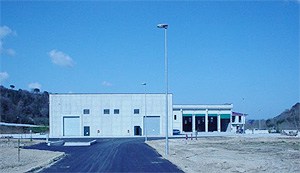 Entsorga already runs an MBT in southern Italy, which treats black bag residual waste |
The new facility is being designed to process 60,000 tonnes of mixed household waste collected in West Wiltshire each year. It will remove recyclable materials and produce about 30,000 tonnes of refuse-derived fuel to displace fossil fuels used in the nearby Lafarge cement works.
Hopes are to have the 12 million plant up and running by 2008.
The first of its kind in Britain, Entsorga's “high efficiency biological treatment” or “HeBIOT” system will be similar to a facility Entsorga completed in southern Italy in 2003. This Italian plant was initially designed to treat 30,000 tonnes of source-separated waste each year, but has since been converted to take residual waste.
The company believes its link-up with Lafarge in using solid recovered fuel (SRF) from the Wiltshire plant could be an important step in promoting the use of SRF in the UK as a whole.
Dr Daryl Hill, who represents Entsorga in the UK, said: “We are really pleased to be involved in what will be a landmark project using modern waste treatment technology to divert household waste away from landfill, whilst at the same time helping to reduce fossil fuel use and greenhouse gas emissions; this is truly a local solution.”
Process
Entsorgas offer three types of biological treatment systems – Coccinelle, Scarebo and HeBIOT, which is the type to be used in Wiltshire. This is a hall type system which Entsorga explained is a very flexible system and can be used both for composting and biodrying material to produce a fuel.
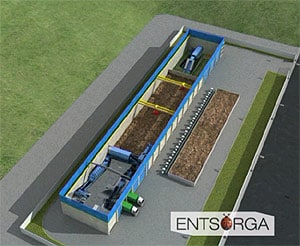 A computer-generated image of the HeBIOT system Entsorga will use in Wiltshire |
The Wiltshire plant will see residual black bag waste broken up inside a building that would be kept at a slightly negative pressure to avoid any odours escaping. Material will undergo physical separation to separate over-sized fractions, which would go direct to the fuel-making process, from the largely organics-containing fraction. This organic material would then go through a 10-14 day process subjected to both microbial decomposition and drying with air blown and sucked through it via air vents in the floor. After this bio-drying process, in which up to 30% of the material's mass is lost by evaporation, metals and inert materials are physically separated and the substitute fuel finalised.
Wiltshire county council is currently achieving recycling rates of 30% for household waste, but must dramatically reduce the amount of biodegradable material it sends to landfill to meet government targets.
Along with the Westbury MBT project, Wiltshire is planning to use the Viridor-Grundon incinerator at Colnbrook, Berkshire, to cut its landfill use, in a 25-year, 300 million project (see letsrecycle.com story).

Subscribe for free