

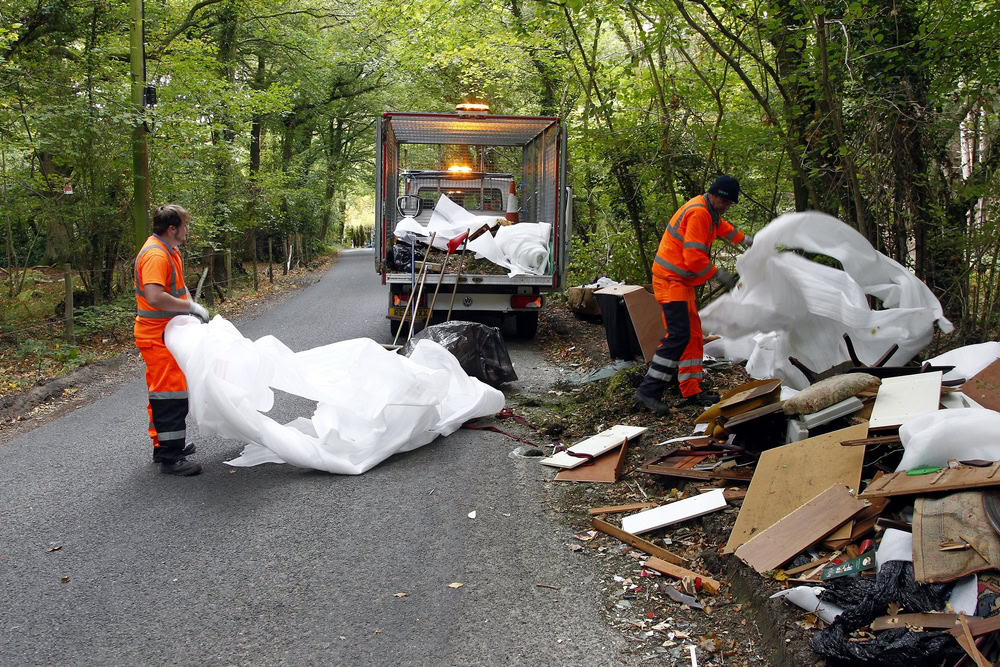
According to statistics released by Defra, the Environment Agency (EA) also dealt with 98 incidents of large-scale illegal dumping, which were not included in this notice. The figures also do not include incidents cleared by private landowners.
Household waste remained the dominant material type, accounting for 62% of all fly-tipping incidents in 2024/25. In total, there were 777,000 incidents involving household waste, a 13% increase from 688,000 in 2023/24.
The data indicated that smaller-scale disposals continue to make up the bulk of cases.
The most common size category in 2024/25 was the equivalent of a s “small van load”, representing 31% of total incidents. This was followed by incidents equivalent to a “car boot or less”, which made up 27%.
However, larger incidents also increased. Around 52,000 incidents – approximately 4% of the total – were categorised as “tipper lorry load” size or larger, an 11% rise from 47,000 in 2023/24.
Highways remain hotspot
Highways (including pavements and roads) continued to be the most common location for fly-tipping, accounting for 37% of all incidents in 2024/25.
Councils recorded 463,000 highway incidents during the year, a 9% increase from 427,000 in 2023/24.
Incidents on council-owned land – such as housing estates, car parks, parks and council offices – increased at a faster rate, rising 13% from 197,000 to 223,000 incidents.
Enforcement activity increases
Local authorities carried out 572,000 enforcement actions in 2024/25, up 8% from 530,000 the previous year.
The number of fixed penalty notices (FPNs) issued rose by 9% to 69,000, compared to 63,000 in 2023/24. FPNs were the second most common enforcement action after investigations, accounting for 12% of all actions taken.
Court activity, however, showed a decline. The total number of court fines fell by 9%, from 1,378 in 2023/24 to 1,250 in 2024/25. The combined value of these fines also decreased by 8%, from £730,000 to £673,000.
Despite the reduction in total fines issued, the average fine increased slightly, rising from £530 in 2023/24 to £539 in 2024/25.
Total enforcement costs for 2024/25 have not been estimated, as accurate figures were unavailable for the majority of enforcement categories.
Enforcement budget increased by 50%
The EA announced a new package of surveillance and investigative measures aimed at strengthening its response to waste crime last week (20 February 2026).
The measures include expanded drone capability, new digital screening tools and a larger specialist enforcement unit, supported by a previously-announced 50% increase in enforcement funding for the agency.
Environment Secretary Emma Reynolds commented on the investment: “This Government is aggressively pursuing waste criminals and bringing offenders to justice.
“By increasing the EA’s enforcement budget by over 50% to £15.6 million, we’re investing in cutting‑edge technology that allows us to shut down illegal operators faster and more effectively.”
Mounting criticism over waste crime
Recent reports have sparked fresh questions over how effectively the UK is tackling fly-tipping and wider waste crime – a problem that the EA said is costing the economy around £1 billion a year.
Breaches range from household dumping to massive “illegal waste sites” created by organised criminal groups.
ESA Chairman and Executive Vice President UK, SUEZ Group, John Scanlon, commented: “It is no surprise that we’re seeing a significant increase in fly-tipping incidents given the slow pace of progress towards regulatory and enforcement reform.
“It remains too easy for criminals to get their hands on waste and to exploit holes in under-resourced regulation. Our sector has long called for competency-based licensing for those that collect, transport and trade waste material, combined with digital waste tracking.
“This would help stop waste from falling into the wrong hands and ensure that it is treated responsibly. However, regulation is only as good as enforcement, so we also need to see better-resourced, tougher, enforcement and stricter sentences for those prosecuted.”
A letsrecycle.com inquiry found that since being granted Section 109A powers under the Environment Act in April 2018 – designed to allow rapid court-ordered Restriction Orders to block access to sites and prevent further dumping – the EA has invoked these unique powers only six times in seven years.
These orders were used in high-profile cases such as Hoad’s Wood in Kent and, more recently, at a site in Kidlington, Oxfordshire that saw hundreds of tonnes of rubbish illegally deposited.
The controversy has been amplified by a House of Lords Environment and Climate Change Committee inquiry, which recently labelled the EA’s approach to waste crime as “inadequate”.


Register for free to comment